Shelters, Highways, and Fear: How the B-36 Peacemaker Quietly Built America's Civil Defense Nation
The B-36 Peacemaker was never intended as a weapon of terror directed at American citizens, yet its very existence as a nuclear-capable strategic bomber reshaped how the United States government prepared ordinary people for the unthinkable. From the concrete arteries of the interstate highway system to the yellow-and-black fallout shelter signs that once adorned nearly every public building, the shadow of the Peacemaker fell across domestic life in ways that historians rarely connect to the aircraft itself.
To understand that connection, one must first appreciate what the B-36 represented in the minds of American defense planners during the late 1940s and early 1950s. Here was an aircraft of almost incomprehensible range and payload capacity, capable of delivering thermonuclear weapons to targets thousands of miles from its home base without refueling. If the United States possessed such a weapon, planners reasoned with cold logic, then it was only a matter of time before an adversary developed a comparable capability. The bomber gap — that anxious, contested space between what America had and what the Soviet Union might eventually achieve — became the psychological engine driving an entire generation of domestic preparedness policy.
A Nation Forced to Reckon With Its Own Vulnerability
Before the B-36 entered operational service with Strategic Air Command in 1948, American civil defense thinking remained largely a residue of World War II experience: air raid wardens, blackout curtains, and the kind of neighborhood-level preparedness that had proven effective against conventional bombing campaigns in European cities. Nuclear weapons had changed the calculus fundamentally, but the sheer scale of that change had not yet been fully absorbed into policy.
The B-36 forced that absorption. Military analysts who had spent years studying the aircraft's capabilities understood that a nuclear-armed bomber of its class could effectively destroy an entire metropolitan area in a single pass. The radius of destruction associated with thermonuclear weapons made traditional civil defense concepts — the shelter-in-place tactics and neighborhood warden systems borrowed from the British experience — appear almost quaint by comparison. Something far more comprehensive, and far more expensive, would be required.
The Federal Civil Defense Administration, established in 1950, was in many respects a direct institutional response to this recognition. Its founding mandate acknowledged, however obliquely in public communications, that American cities now faced a qualitatively different threat than anything encountered in prior conflicts. The language of official civil defense literature from this period consistently referenced the threat of "enemy bombers" capable of delivering weapons of mass destruction — a description that fit the B-36 and its Soviet counterparts with equal precision.
The Interstate System's Hidden Strategic Logic
Perhaps no domestic infrastructure project better illustrates the B-36's indirect influence on American life than the Federal Aid Highway Act of 1956, which authorized the construction of the Interstate Highway System. President Dwight D. Eisenhower, whose thinking on strategic matters had been shaped by decades of military experience, understood the dual-use potential of a national highway network with particular clarity.
The official justification for the interstate system emphasized economic development and the facilitation of commerce, and those benefits were genuine. However, internal planning documents from the period reveal an equally prominent concern with military mobility and, critically, with civilian evacuation. Defense planners had modeled the likely consequences of a nuclear strike on major American cities and concluded that the existing road network was wholly inadequate for the rapid movement of millions of people away from target areas.
The design specifications written into the Interstate Highway Act reflect this concern in concrete terms. Overpasses were engineered to minimum height clearances that would accommodate military vehicles. Certain stretches of highway were designed to serve as emergency landing strips for military aircraft. The system's connectivity was explicitly intended to ensure that the destruction of any single node — any single city — would not sever the national transportation network. Every one of these specifications traced its origins, at least in part, to the threat model embodied by long-range nuclear-capable bombers of the B-36's generation.
The Architecture of Shelter
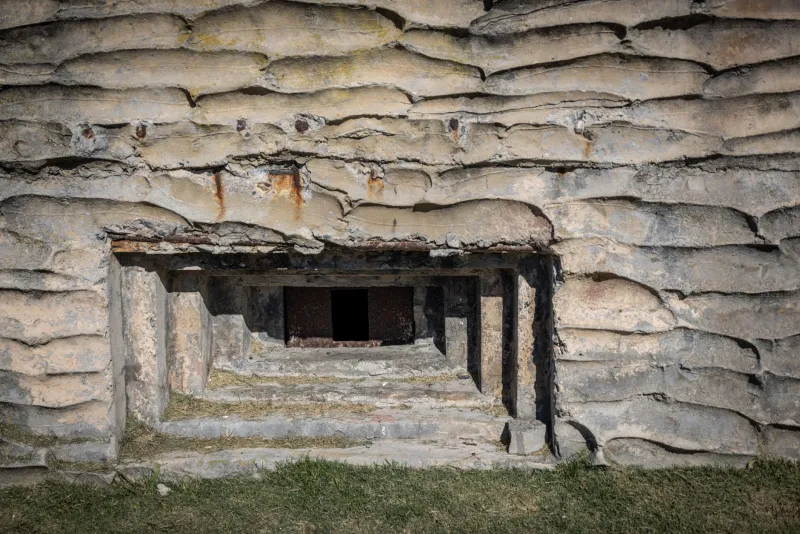
If highways represented the evacuation logic of civil defense, fallout shelters represented its survivability logic — and here again, the B-36's shadow is visible in the historical record. The transition from simple blast shelters, designed to protect occupants from the immediate concussive effects of a nuclear detonation, to the more broadly conceived fallout shelter program of the late 1950s reflected a growing understanding of how nuclear weapons actually killed people at distances beyond the immediate blast radius.
The National Fallout Shelter Survey, conducted in the early 1960s, identified and marked thousands of existing structures — office buildings, schools, parking garages, subway stations — as potential shelter locations based on their ability to attenuate radiation exposure. The familiar yellow-and-black shelter signs that became fixtures of American public life were the visible tip of an enormous administrative and architectural enterprise, one that required the systematic evaluation of virtually every substantial public building in the country.
Planning documents from this era make clear that the threat driving these calculations was explicitly framed in terms of bomber capabilities. The yield assumptions used to model radiation exposure, the distance calculations used to determine which structures offered meaningful protection, and the population distribution models used to assess how many people could realistically be sheltered in urban areas — all of these were calibrated against the delivery capabilities of strategic bombers operating at the scale and range that the B-36 had first demonstrated was achievable.
Civil Defense on Main Street
The B-36's influence on American civil preparedness extended well beyond infrastructure into the fabric of everyday cultural life. The "duck and cover" drills conducted in schools across the country throughout the 1950s, the basement shelter construction guides distributed by the Office of Civil Defense Management, and the community preparedness exercises that mobilized local governments in cities from Portland, Maine, to Portland, Oregon — all were downstream consequences of the strategic reality that the B-36 had helped to define.
Ordinary Americans who participated in these programs rarely connected their experience to a specific aircraft. They knew, in a general sense, that the threat came from Soviet bombers, and they knew that nuclear weapons were involved. What they could not have known was the degree to which the specific technical parameters of the threat — the range, the payload, the altitude capabilities — had been shaped by American engineers working on the B-36 program and their Soviet counterparts who had studied it with intense professional interest.
In this sense, the Peacemaker's most lasting domestic legacy may be invisible to those who lived through it. The highways they drove, the shelter signs they passed without reading, the drills they participated in as schoolchildren — these were all, in a meaningful historical sense, architectural responses to the existence of an aircraft that most Americans had never seen and could not have named.
Reassessing the Aircraft's Domestic Legacy
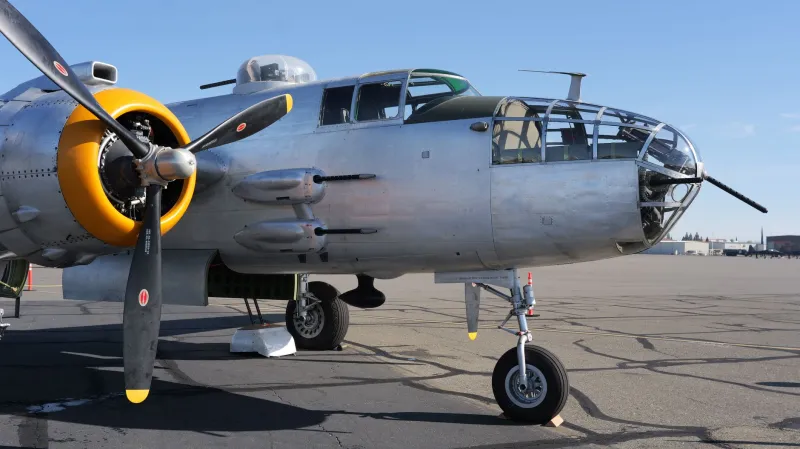
For visitors to the B-36 Peacemaker Museum, the aircraft on display represents a remarkable chapter in aviation and military history. Its dimensions alone command attention; its technical sophistication invites admiration. But the full measure of the Peacemaker's historical significance cannot be taken from the flight line alone.
The B-36 shaped America not only through what it was capable of doing to adversaries abroad, but through what its capabilities implied about American vulnerability at home. The infrastructure built in response to that implied vulnerability — the highways, the shelters, the institutional apparatus of civil defense — represents a physical and organizational legacy that outlasted the aircraft itself by decades. Understanding the B-36 fully means understanding that its influence extended far beyond the airfields of Strategic Air Command, reaching into the everyday lives of a nation that spent a generation preparing for a war it earnestly hoped would never come.