After the Bomb Bay: How Retired B-36 Peacemakers Became Flying Laboratories for a New Scientific Age
For most Americans, the B-36 Peacemaker's story ends with retirement — a fleet of aging giants quietly withdrawn from Strategic Air Command service as the jet-powered B-52 Stratofortress assumed the mantle of deterrence. Yet for a small cohort of airframes, decommissioning was not a conclusion but a transformation. Stripped of their nuclear mission, these aircraft were repurposed into something far removed from their original purpose: airborne laboratories capable of carrying experiments, instrumentation, and test equipment that no other platform of the era could accommodate.
Understanding why the B-36 proved so attractive to experimenters requires revisiting the aircraft's fundamental engineering. With a wingspan of 230 feet, a pressurized fuselage stretching nearly 163 feet, and a combined bomb bay volume exceeding 2,500 cubic feet, the Peacemaker offered interior space that dwarfed virtually every other aircraft in the American inventory. Its six reciprocating engines — supplemented in later variants by four jet pods — provided the range and loiter time that short-range test aircraft simply could not match. For researchers who needed to carry large, heavy, or sensitive payloads over long distances at sustained altitudes, the B-36 was an almost self-evident choice.
Converting a Colossus: The Engineering Challenge of Repurposing
Transforming a strategic bomber into a research platform was not a trivial undertaking. The conversions demanded careful structural analysis, since the bomb bays and fuselage sections that had been designed to carry nuclear weapons now needed to support radically different loads — antenna arrays, sensor packages, pressurized instrument capsules, and in some cases, smaller experimental aircraft suspended beneath the fuselage.
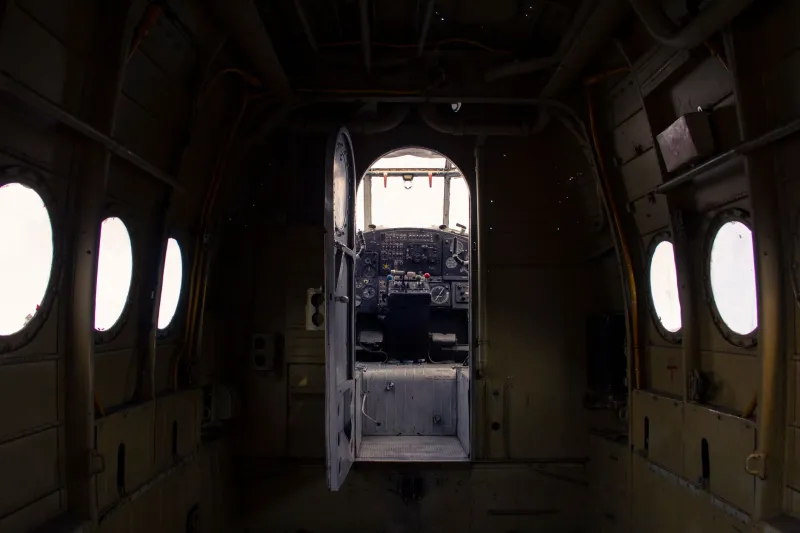
Convair engineers and Air Force depot teams worked through a series of modifications that varied considerably depending on the intended mission. In some configurations, the forward bomb bays were fitted with custom-built equipment racks and climate-controlled enclosures to protect sensitive electronics from the thermal extremes encountered at high altitude. In others, the aft sections were reconfigured to accommodate specialized operators who monitored real-time data feeds during flight. The aircraft's existing pressurization systems were frequently extended or upgraded to serve these new interior arrangements, ensuring that both personnel and instruments could function reliably during long-duration sorties.
One of the more demanding conversion challenges involved structural reinforcement for external stores. Certain experimental programs called for mounting test articles — prototype sensors, antenna configurations, or aerodynamic shapes — beneath the wings or fuselage, exposing the airframe to aerodynamic loads it had not been designed to carry in those locations. Addressing these requirements called for the kind of detailed engineering work that rarely receives public attention but was absolutely essential to the aircraft's success as a test platform.
Listening to the Upper Atmosphere: Scientific Research Missions
Among the most consequential of the B-36's post-bomber roles was its service as a high-altitude atmospheric research vehicle. During the late 1950s, American scientists were engaged in an intensive effort to understand the composition and behavior of the upper atmosphere — work that carried both purely scientific significance and direct implications for the development of ballistic missiles, reconnaissance aircraft, and eventually spacecraft.
The Peacemaker's ability to reach altitudes above 40,000 feet while carrying substantial instrument payloads made it a practical choice for atmospheric sampling missions. Research teams used converted airframes to collect air samples, measure cosmic ray flux, and study the behavior of various materials under prolonged exposure to stratospheric conditions. Some of this work fed directly into the development of life support systems for high-altitude aircraft and early spacecraft, creating a quiet but meaningful connection between the B-36 and the emerging space program.
Beyond atmospheric chemistry, the aircraft also served as a platform for early radar and electronic intelligence research. The Cold War imperative to understand Soviet air defense capabilities drove an enormous investment in airborne electronics testing during this period, and the B-36's cavernous interior could house the large, power-hungry electronic systems that such research demanded. Operators aboard converted Peacemakers gathered signals intelligence, tested new radar configurations, and evaluated jamming and countermeasure technologies — all in an era before purpose-built electronic warfare aircraft had fully matured.
The Parasite Connection: Carrying Experimental Aircraft Aloft
Perhaps the most visually striking of the B-36's experimental roles grew directly from a program that had actually begun during its active service years: the carriage of smaller aircraft beneath the fuselage. The original "parasite fighter" concept — which envisioned jet fighters like the XF-85 Goblin being launched and recovered from the bomber in flight — had been abandoned as impractical for combat use. But the underlying capability proved genuinely useful in a research context.
By suspending experimental aircraft or test vehicles beneath the B-36's fuselage, researchers could carry them rapidly to altitude and release them under controlled conditions. This approach was particularly valuable for testing configurations that could not sustain conventional takeoff and landing, or for replicating the high-altitude, high-speed conditions that a ground-launched aircraft might take considerable time and fuel to achieve. The B-36 effectively served as a reusable first stage, delivering test articles to their required starting conditions with a reliability and repeatability that alternative methods struggled to match.
This role placed the Peacemaker in an interesting historical lineage. The concept of using a large aircraft as an airborne launch platform has persisted across the decades, finding expression in programs from the X-15 rocket plane to modern commercial satellite launch ventures. The B-36's contribution to that tradition is rarely acknowledged, but the operational experience accumulated during its experimental sorties informed the development of subsequent mothership aircraft and helped establish the procedural frameworks that later programs would refine.
Preserving the Record of a Forgotten Chapter
For historians and archivists at institutions dedicated to the B-36 Peacemaker's legacy, the experimental conversion programs represent one of the most challenging areas of research. Documentation of these activities was often classified at the time, and declassification has proceeded unevenly over the decades. Flight logs, modification records, and program reports are scattered across multiple archives, and the personnel who conducted this work are, in many cases, no longer available to provide firsthand accounts.
Nevertheless, the effort to reconstruct this chapter of the aircraft's history is well underway. Declassified Air Force records, Convair engineering documents held in private collections, and the recollections of surviving technicians and researchers have collectively yielded a picture of considerable richness. What emerges is a portrait of an aircraft that refused to be merely a relic — one that continued contributing to American aviation and scientific progress even as its combat mission receded into history.
The B-36's experimental second act is a reminder that great aircraft rarely tell their full story in the pages most commonly read. The Peacemaker's strategic deterrence role is rightly celebrated, but the laboratories it carried aloft, the experiments it enabled, and the knowledge it helped generate deserve recognition as well. In preserving and communicating that history, we honor not just the aircraft itself, but the ingenuity of the men and women who found new purpose in its extraordinary capabilities long after the Cold War's first chapter had closed.