Entombed in the Desert: What the Southwest's Aircraft Boneyards Reveal About the B-36 Peacemaker's Forgotten Fate
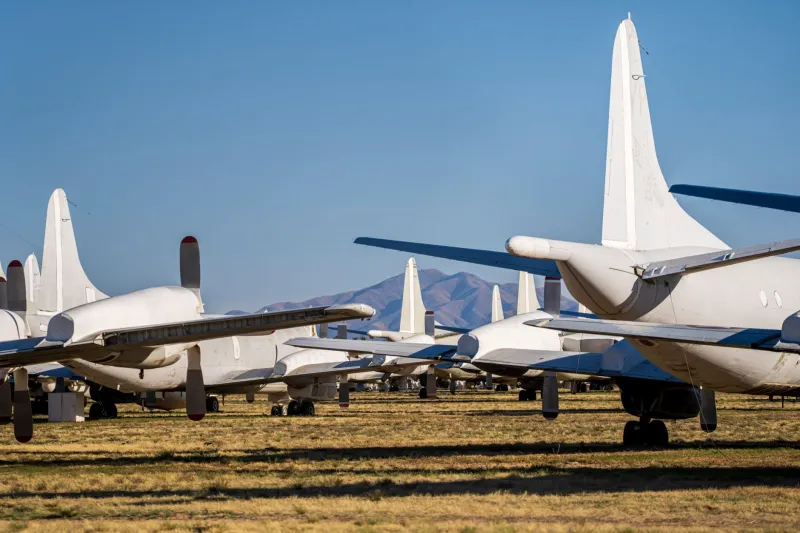
The Sonoran Desert is a patient custodian. Its bone-dry air, relentless heat, and negligible annual rainfall have long made the American Southwest a preferred location for storing retired military aircraft — a climatic accident of geography that has, in several notable cases, preserved hardware that would have otherwise vanished entirely. Among the most historically significant beneficiaries of this arrangement are the remnants of the B-36 Peacemaker fleet, America's first truly intercontinental nuclear bomber. What remains of these aircraft in desert storage facilities tells a complicated story about bureaucratic indifference, institutional memory, and the fragile line between preservation and permanent loss.
The Logic of the Boneyard
To understand why B-36 airframes ended up in desert storage at all, it is necessary to appreciate how the United States military has historically managed the retirement of large aircraft. The 309th Aerospace Maintenance and Regeneration Group at Davis-Monthan Air Force Base near Tucson, Arizona — commonly known as the "Boneyard" — has served since the 1940s as the nation's primary repository for retired military aircraft. The facility's value is straightforward: aircraft stored in the desert require minimal corrosion-prevention treatment, their systems can be cannibalized to support active fleets, and the land itself is inexpensive to maintain.
When Strategic Air Command began phasing out the B-36 in the late 1950s, the transition was swift and largely unsentimental. The aircraft had been rendered strategically obsolete by the jet-powered B-52 Stratofortress, and the institutional appetite for preserving what had so recently been a frontline weapon was limited. Most airframes were scrapped with remarkable efficiency. A smaller number, however, were routed toward storage or tentative preservation — a process that was, by most accounts, inconsistent and driven as much by logistical happenstance as by any coherent archival philosophy.
Which Airframes Survived, and Why
The question of why certain B-36s were preserved while the overwhelming majority were destroyed does not yield a clean answer. Archival research and interviews with former Air Force logistics personnel suggest that the selection process was influenced by a combination of factors: the physical condition of individual airframes at the time of retirement, the proximity of a given aircraft to a base or installation that had expressed interest in static display, and occasionally the advocacy of individual officers who recognized the aircraft's historical significance.
Several airframes that were nominally designated for preservation in the late 1950s and early 1960s suffered fates that were only marginally better than outright scrapping. Exposure to the elements, inadequate sheltering, and the gradual cannibalization of parts for ground training or display purposes eroded their integrity over the following decades. By the time civilian aviation museums and historical organizations began actively seeking B-36 examples in the 1970s and 1980s, the pool of recoverable aircraft had shrunk considerably.
What remains today in various states of outdoor storage across the Southwest represents the residue of a preservation effort that was never fully organized or adequately funded. Some of these airframes retain enough structural integrity to be assessed for potential restoration. Others have deteriorated to the point where their value is primarily documentary — useful as sources of dimensional data, material samples, and manufacturing detail, but not viable candidates for museum display in any recognizable form.
The Technical Case Against Recovery
Restoring a B-36 to even static display condition is an undertaking of formidable complexity. The aircraft's sheer scale — a wingspan exceeding 230 feet and a gross weight that could surpass 410,000 pounds at maximum load — creates logistical challenges that have no real parallel in the restoration of smaller vintage aircraft. Transporting a substantially intact airframe requires the cooperation of state highway authorities, the temporary removal of overhead infrastructure along transportation corridors, and the availability of heavy-lift equipment that is not commonly maintained by civilian restoration organizations.
Beyond the physical challenges of transport, the technical condition of desert-stored B-36 components presents serious obstacles. Aluminum alloys used in the aircraft's construction are susceptible to a specific form of intergranular corrosion that is not always visible on the surface but can substantially compromise structural integrity. Rubber seals, fuel bladders, and hydraulic lines have long since exceeded any meaningful service life. Electrical wiring insulation has degraded to the point of brittleness across most surviving examples. Restoration specialists who have assessed desert-stored airframes generally describe the task in terms of reconstruction rather than restoration — a distinction with significant implications for both cost and historical authenticity.
Conservative estimates for returning a substantially deteriorated B-36 airframe to stable static display condition have ranged from several million to tens of millions of dollars, depending on the extent of structural remediation required. For organizations operating on the budgets typical of nonprofit aviation museums, such figures represent an existential financial commitment.
Legal and Institutional Barriers
The technical challenges of B-36 recovery are compounded by a regulatory environment that has grown considerably more complex since the aircraft's retirement. Title to surviving military airframes generally remains with the United States government unless formally transferred through the General Services Administration's surplus property program or a dedicated loan agreement administered by the National Museum of the United States Air Force. Navigating these processes requires sustained institutional engagement, legal counsel familiar with federal property law, and the patience to work within bureaucratic timelines that can extend across years.
Further complicating matters is the question of hazardous materials. Aircraft of the B-36's era were constructed and finished using compounds that are now subject to strict environmental regulation, including certain primers, sealants, and hydraulic fluids that contain materials classified as hazardous waste under current Environmental Protection Agency standards. Any restoration effort must account for the proper identification, containment, and disposal of these substances — an added layer of cost and procedural complexity that did not confront the organizations that successfully recovered B-36 examples in earlier decades.
What These Aircraft Still Have to Say
Despite the obstacles, the case for continued engagement with surviving desert-stored B-36 airframes is not merely sentimental. These aircraft are physical archives. Their construction details, material compositions, and manufacturing markings carry information about mid-twentieth-century American industrial capacity and military procurement practices that is not fully captured in documentary records alone. Metallurgical analysis of original structural components can inform our understanding of the engineering tolerances that governed Cold War-era bomber design. Surviving avionics hardware, even in degraded condition, provides tangible evidence of the electronic systems that underpinned America's nuclear deterrent during one of history's most consequential strategic standoffs.
For aviation historians and Cold War researchers, the boneyard airframes represent a category of primary source material that, once lost, cannot be recovered. The institutional challenge facing preservation organizations today is not simply one of funding or logistics — it is one of articulating, convincingly and urgently, why the effort matters before the desert finishes what time has already begun.
A Question of Will
The B-36 Peacemaker Museum regards the condition of desert-stored airframes as both a cautionary lesson and an ongoing obligation. The history of these aircraft did not end when Strategic Air Command retired the last example in 1959. It continued through decades of institutional neglect, partial preservation, and gradual deterioration — a history that is itself worth documenting and understanding. Whether any of the remaining desert-stored airframes can be saved depends on decisions that have not yet been made, by organizations and agencies that have not yet committed to making them. The sleeping giants of the Southwest are not beyond reach. But the window for meaningful action is narrowing with each passing season.