The Adversary's Answer: How the B-36 Peacemaker Forced the Soviet Union to Reinvent Its Entire Defense Apparatus
There is a particular irony embedded in the B-36 Peacemaker's Cold War legacy. Despite completing its operational service without ever flying a combat mission against the adversary it was designed to deter, the aircraft exerted a profound and lasting influence on Soviet military thinking. From the drawing boards of MiG design bureaus to the classified conference rooms of the Soviet General Staff, the looming presence of America's intercontinental bomber shaped decisions that would reverberate through the entire Cold War era. Understanding that influence requires looking beyond American archives and into the strategic calculations of the men who feared what the Peacemaker represented.
A Threat That Arrived Before the Defenses Were Ready
When the B-36 entered operational service with Strategic Air Command in 1948, Soviet air defense infrastructure was, by any honest assessment, woefully inadequate to meet the challenge it posed. Soviet radar networks were fragmented and geographically uneven, concentrated primarily in western regions that had borne the brunt of German air attacks during World War II. The vast Siberian interior—precisely the approach corridors an American bomber flying over the polar route would exploit—remained largely unmonitored.
Soviet planners understood the arithmetic of the situation with uncomfortable clarity. The B-36 could carry nuclear weapons across intercontinental distances, cruise at altitudes exceeding 40,000 feet, and sustain flight for durations that made any existing Soviet interceptor's range look inadequate by comparison. The piston-powered variants of the early B-36 were, in many respects, less dangerous than the later jet-augmented models, which could reach speeds approaching 435 miles per hour at altitude. For Soviet air defense commanders, the aircraft represented a moving target that exposed every weakness in their existing doctrine simultaneously.
The Fighter Gap and the Race to Close It
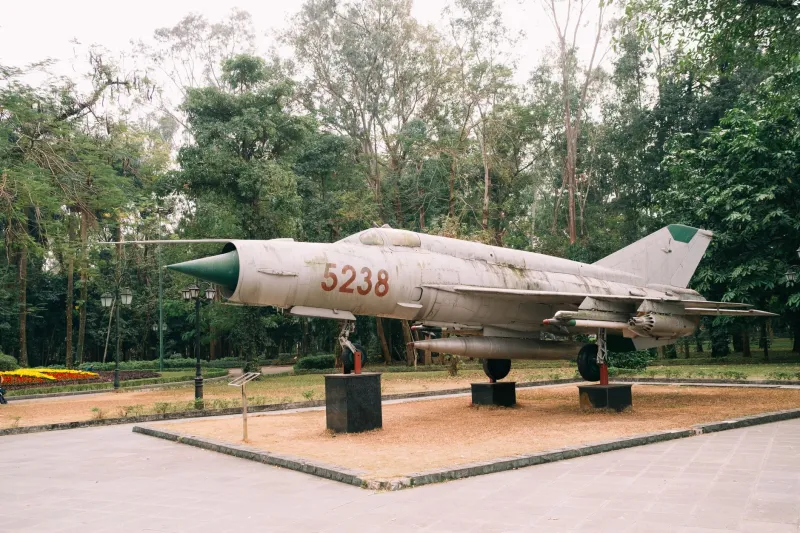
Perhaps no consequence of the B-36's existence proved more consequential for Soviet military development than the urgent acceleration of high-altitude jet interceptor programs. The MiG-15, though celebrated for its performance against American aircraft during the Korean War, was not specifically optimized for the high-altitude interception mission that engaging a B-36 would demand. Soviet test pilots who evaluated captured American aircraft performance data recognized that a successful intercept required sustained high-altitude capability, a powerful cannon armament capable of inflicting lethal damage in a brief firing pass, and—critically—an aircraft that could actually reach the bomber before it completed its run.
The response was the development of dedicated high-altitude interceptor platforms, most notably the MiG-17 and its successors. Soviet design bureaus received explicit guidance to prioritize ceiling performance alongside speed. The Lavochkin design bureau pursued experimental aircraft specifically intended to operate above 50,000 feet, while Yakovlev engineers worked on interceptor concepts that could be vectored rapidly to altitude by ground controllers. Each of these programs bore the unmistakable imprint of the B-36 threat assessment embedded in their design requirements.
Restructuring the Air Defense Network
Beyond fighter development, the B-36's operational characteristics forced a fundamental reorganization of Soviet strategic air defense as an institutional enterprise. In 1948, Soviet air defense functions were distributed across multiple commands with overlapping and sometimes contradictory jurisdictions. By the early 1950s, Soviet leadership had concluded that this arrangement was strategically untenable in the face of the American bomber threat.
The result was the creation and gradual empowerment of Voyska protivovozdushnoy oborony—the Soviet Air Defense Forces, commonly abbreviated as PVO Strany. This dedicated command structure, which would eventually grow into one of the most elaborate air defense networks ever constructed, owed much of its institutional rationale to the perceived necessity of countering the B-36 and its successors. Radar installations multiplied across the Soviet interior. Early warning networks were extended northward toward the Arctic approaches. Ground-controlled interception procedures were formalized and rehearsed with a regularity that reflected genuine operational urgency rather than peacetime routine.
Declassified Soviet documents made available after the Cold War's end confirm that American strategic bomber capabilities—with the B-36 foremost among them during the early 1950s—were the explicit justification presented to Soviet leadership when requesting the enormous resources necessary to build this defensive infrastructure.
The Surface-to-Air Missile Imperative
Soviet planners harbored few illusions about their interceptor force's ability to guarantee destruction of a determined B-36 strike package. Even with improved fighters and better radar coverage, the mathematics of attrition favored the attacker in scenarios where bombers approached from multiple vectors simultaneously. This sobering recognition accelerated Soviet investment in surface-to-air missile technology at a pace that might otherwise have seemed premature given the state of the underlying engineering.
The SA-1 Guild system, deployed around Moscow beginning in the early 1950s, represented the first tangible expression of this imperative. While its operational effectiveness against actual B-36 aircraft was never tested in combat, its development timeline correlates directly with the period during which the Peacemaker represented the primary American strategic threat. Soviet engineers working under Semyon Lavochkin's guidance on missile guidance systems were operating under explicit performance specifications derived from B-36 flight characteristics—altitude, speed, and radar cross-section estimates drawn from intelligence collection and analysis.
The institutional knowledge accumulated during these early missile programs fed directly into subsequent generations of Soviet air defense missiles, establishing a technological lineage that stretched from the SA-1 through the formidable SA-2 Guideline and beyond.
Strategic Doctrine Under Pressure
At the highest levels of Soviet strategic thinking, the B-36's existence contributed to a gradual but significant shift in how Soviet planners conceptualized the relationship between offensive and defensive military power. Traditional Soviet military doctrine, shaped by the experience of World War II, emphasized mass land forces and offensive operations as the primary instruments of national security. The emergence of American strategic air power—embodied most visibly in the B-36—complicated this framework by introducing a threat that could strike Soviet territory directly and with catastrophic effect, entirely bypassing the land forces in which Moscow had invested so heavily.
This recognition helped accelerate Soviet interest in their own strategic bomber program and, eventually, in ballistic missile development as a means of holding American territory at risk in a manner analogous to what the B-36 represented for the Soviet Union. The logic of mutual vulnerability that would eventually underpin Cold War deterrence theory was, in part, a response to the strategic reality the Peacemaker had introduced.
An Aircraft That Fought Without Flying
The B-36 Peacemaker's most enduring military contribution may well lie not in any mission it flew but in the reactions it compelled from the nation it was designed to deter. Soviet air defense institutions, interceptor programs, surface-to-air missile development, and strategic doctrine all bear the imprint of decisions made in response to an aircraft that sat, largely quiet, in Strategic Air Command bases across the American heartland.
For historians and aviation enthusiasts who engage with the Peacemaker's legacy, this dimension of its story offers a genuinely remarkable lesson about how weapons shape history not merely through their use but through the fear and adaptation they generate in those who must reckon with them. The B-36 never needed to cross Soviet borders to change the course of the Cold War. Its shadow was sufficient.