Deterrence Made Flesh: How the B-36 Peacemaker Redefined American Power and Cold War Strategy
There is a particular kind of power that operates through restraint — through the credible threat of action never taken. In the years immediately following World War II, the United States found itself in urgent need of exactly that kind of power. The Soviet Union had emerged from the conflict as an ideological adversary of continental scale, and American military planners faced a sobering question: how does a democracy project overwhelming force without committing to permanent war? The answer, as it turned out, would take shape on the drawing boards of Consolidated Vultee Aircraft Corporation in Fort Worth, Texas. The B-36 Peacemaker did not simply carry bombs. It carried consequences — and the weight of those consequences fundamentally transformed how America understood its role in the world.
From Wartime Contingency to Cold War Cornerstone
The B-36 was originally conceived during the darkest days of World War II, when planners feared that Britain might fall and American bombers might need to reach European targets directly from the continental United States. That mission never materialized, but the aircraft it produced arrived precisely when a new and more enduring confrontation demanded its capabilities.
By 1948, the Strategic Air Command — then under the early stewardship of General Curtis LeMay — was a force in serious need of credibility. Its aircraft were largely holdovers from the previous conflict, and its operational readiness was, by many internal assessments, alarmingly deficient. The arrival of the B-36 in meaningful numbers changed that calculus in ways that extended far beyond the tarmac. Here was a bomber capable of reaching any point on the Soviet landmass from bases in the continental United States, loitering over a target, and returning without aerial refueling. No Soviet fighter in existence could reliably intercept it at altitude. No radar network of the era could guarantee its detection in sufficient time to mount a coordinated defense.
The Peacemaker was not merely a weapons platform. It was an argument — one made in the language of physics and geography rather than diplomacy.
The Berlin Crisis and the Weight of Presence
The first major test of that argument came in 1948, when the Soviet Union imposed a blockade on West Berlin. President Harry Truman faced an acute dilemma: capitulate to Soviet pressure and abandon American commitments, or risk a confrontation that could escalate with terrifying speed. The famous airlift that followed has rightly been celebrated as a triumph of logistical ingenuity, but the airlift did not operate in a vacuum. Behind it stood the implicit threat of American strategic air power.
B-36 deployments to forward bases in Britain and elsewhere during this period were not accidental. They were deliberate signals — visible demonstrations that the United States possessed both the will and the means to respond to Soviet aggression at a level the Kremlin could not afford to absorb. Soviet leadership, acutely aware of American nuclear monopoly in those years, calculated accordingly. The blockade was lifted in May 1949 without a shot fired between the superpowers. Historians have long debated the precise weight of each factor in that outcome, but the presence of American strategic bombers capable of reaching Moscow was not incidental to Soviet decision-making.
Massive Retaliation and the Doctrine It Made Possible
The election of Dwight D. Eisenhower in 1952 brought with it a fundamental reassessment of American defense spending and strategic philosophy. Eisenhower, acutely conscious of the economic burden that permanent military mobilization imposed on democratic societies, sought a doctrine that would provide maximum deterrent effect at sustainable cost. The result — articulated most clearly in the New Look defense policy of 1953 and Secretary of State John Foster Dulles's subsequent doctrine of massive retaliation — depended entirely on the existence of a credible, long-range nuclear delivery capability.
The B-36 was the material foundation upon which that doctrine rested. Massive retaliation, in essence, promised that any Soviet aggression — conventional or otherwise — would be met with overwhelming nuclear force. It was a doctrine that traded the expense of large standing armies for the comparative economy of strategic air power. Critics would later argue, with considerable justification, that the doctrine was strategically inflexible. But in the early 1950s, it represented a coherent response to the twin pressures of Soviet expansionism and domestic fiscal constraint. None of it was possible without an aircraft that could make the threat credible. The B-36 made it credible.
The Soviet Response and the Architecture of Mutual Fear
The Peacemaker's influence extended beyond American planning rooms. Soviet military and political leadership invested enormous resources in developing countermeasures to the B-36 threat — resources that might otherwise have been directed toward conventional force projection or other strategic priorities. The development of high-altitude interceptor aircraft, advanced radar networks, and surface-to-air missile systems were all accelerated, at least in part, by the imperative of neutralizing the American strategic bomber threat.
In this sense, the B-36 shaped Soviet military development as surely as it shaped American doctrine. The Cold War, at its core, was a contest of reciprocal deterrence — each side's capabilities compelling the other to respond in kind. The Peacemaker was among the first instruments through which that dynamic was fully established. It did not merely threaten the Soviet Union; it reorganized Soviet strategic priorities in ways that reverberated through the entire Cold War competition.
Presidential Authority and the Nuclear Question
The B-36 era also coincided with a critical and underappreciated transformation in the relationship between the presidency and nuclear weapons. In the late 1940s and early 1950s, questions of custody, authorization, and employment of nuclear weapons were far less settled than they would later become. The existence of an operational strategic bomber force — one capable of delivering nuclear weapons on short notice — concentrated the minds of civilian and military leaders alike on the question of who, precisely, controlled that capability and under what circumstances it could be used.
Truman's insistence on civilian control of nuclear weapons, and the institutional frameworks that gradually formalized that control during the B-36 years, were responses to a concrete operational reality. The bomber made the question urgent in a way that abstract policy discussions never could. In demanding answers, it helped construct the command-and-control architecture that would govern American nuclear policy for decades.
A Legacy Written in Strategy
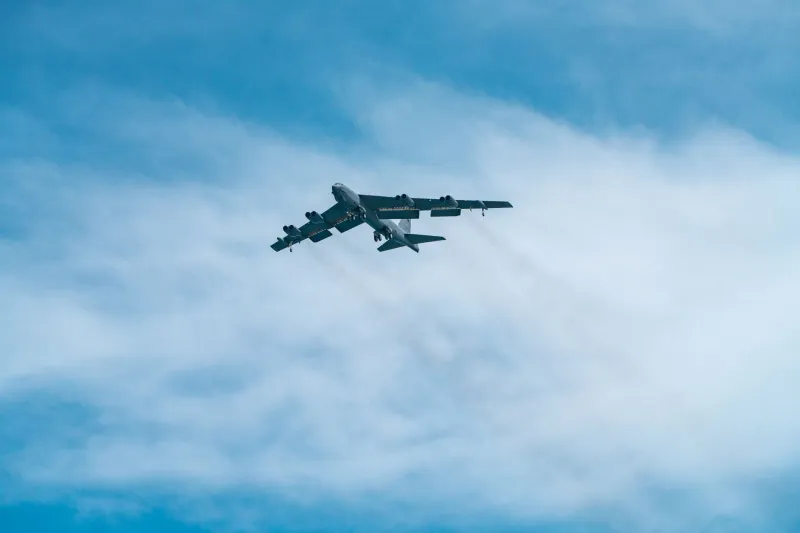
The B-36 Peacemaker left active service by 1959, superseded by the jet-powered B-52 Stratofortress and the emerging generation of intercontinental ballistic missiles. But the strategic world it helped create did not dissolve with its retirement. The doctrines of deterrence, the emphasis on credible second-strike capability, the institutionalization of civilian nuclear authority — all of these endured, carrying forward the intellectual and strategic inheritance of the Peacemaker years.
At the B-36 Peacemaker Museum, we believe that understanding this aircraft requires understanding the world it made. Its wingspan measured 230 feet. Its strategic shadow was considerably larger. To walk the floor beside a surviving Peacemaker is to stand in the presence not merely of a machine, but of a decision — a choice made by a generation of Americans about how a free society would defend itself in an age of unprecedented danger. That choice, and the aircraft that gave it form, deserves to be remembered with the seriousness it commands.