Racing Against Time: The Extraordinary Effort to Save America's Last B-36 Peacemakers
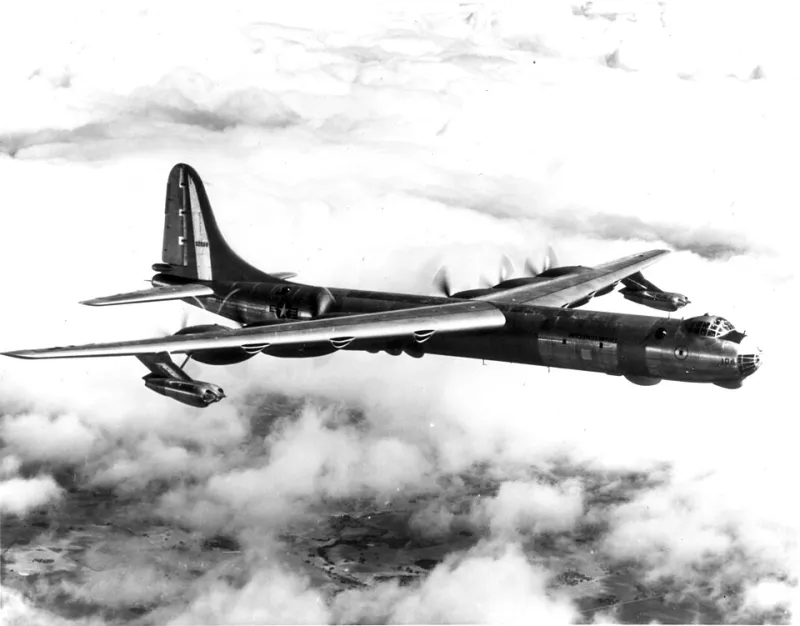
Photo: TimVickers, Public domain, via Wikimedia Commons
Somewhere in a climate-controlled hangar, a volunteer in coveralls is carefully documenting the serial number on a fastener that hasn't been manufactured since the Eisenhower administration. It is painstaking work, unglamorous and slow, but it is precisely this kind of attention that stands between a surviving B-36 Peacemaker and the irreversible decay that has already claimed so many of its sisters.
Of the 384 B-36 aircraft produced between 1947 and 1954, fewer than five complete examples remain today. The rest were scrapped — a fate that seemed entirely reasonable at the time, when the aircraft were obsolete and aluminum was valuable. That decision looks rather different in hindsight. What survives is precious, fragile, and extraordinarily difficult to maintain. The people doing that work deserve to have their story told.
The Scale Problem Nobody Warned You About
Every aircraft restoration project carries its own peculiar challenges, but the B-36 presents difficulties that are genuinely in a category of their own. Begin with the obvious: this is the largest mass-produced piston-engine aircraft in history, with a wingspan of 230 feet and a fuselage length of 162 feet. Moving a B-36 within a museum facility requires logistics planning that most institutions associate with construction projects rather than curatorial work.
Beyond sheer size, the aircraft's complexity is daunting. The B-36 was powered by six Pratt & Whitney R-4360 Wasp Major radial engines — themselves among the most intricate piston powerplants ever built — supplemented by four General Electric J47 jet engines in underwing pods. Each of the six radial engines contains 28 cylinders arranged in four rows of seven. Sourcing replacement components for these powerplants is, to put it charitably, a significant undertaking.
Restoration specialists who have worked on the surviving examples describe the parts sourcing challenge as the central difficulty of any B-36 preservation project. "The aircraft was retired in 1959," explained one veteran airframe mechanic who has contributed to preservation work at a major U.S. air museum. "That's more than six decades of parts going into private collections, being cannibalized for other projects, or simply disappearing. When you need a specific gasket or a particular valve assembly, you're essentially doing archaeology."
The Funding Reality
Preservation work of this magnitude does not happen on enthusiasm alone. The financial requirements for maintaining a B-36 in stable, displayable condition — let alone pursuing active restoration — are substantial, and the funding landscape for aviation museums in the United States is competitive and unpredictable.
Major institutions with B-36 examples in their collections have approached the funding challenge through a combination of strategies. Federal grants through programs administered by the Institute of Museum and Library Services have supported some documentation and stabilization work. Corporate sponsorships from aerospace and defense contractors with historical connections to the program have contributed in certain cases. But the backbone of most B-36 preservation efforts, as museum directors readily acknowledge, is private donation — often from veterans' communities, aviation enthusiasts, and the families of those who flew or maintained the aircraft during its operational years.
The volunteer dimension of this work is impossible to overstate. At institutions across the country, retired mechanics, amateur historians, and aviation hobbyists contribute hundreds of hours annually to tasks ranging from surface cleaning and paint documentation to the more technically demanding work of inspecting structural components and preserving mechanical systems. Without this volunteer labor, several of the surviving B-36 examples would be in considerably worse condition than they are today.
Static Display or Flying Restoration? The Decision That Defines Everything
Among the most consequential choices facing any team working on a surviving B-36 is the question of intent: is the goal to preserve the aircraft as a static exhibit, or to pursue restoration to airworthy condition? This is not merely a technical question. It is a philosophical one, with significant implications for cost, risk, and the ultimate purpose of the preservation effort.
The case for static preservation is compelling on practical grounds. Returning a B-36 to flying condition would require not only the restoration of all ten engines to operational status, but the recertification of fuel systems, hydraulics, flight controls, and avionics — much of which relies on components that are either unavailable or would require custom fabrication. The cost estimates associated with a genuine flying restoration of a B-36 run into figures that most museum budgets cannot realistically contemplate.
Yet the argument for at least maintaining aircraft in a condition from which a future flying restoration might be possible carries its own weight. Museum curators who specialize in historic aircraft preservation often speak of a concept they call "reversibility" — the principle that conservation decisions should not permanently foreclose future options. Stabilizing a B-36 without actively restoring it, while documenting every system and component in detail, preserves the possibility that a future generation with greater resources might complete what the current one can only begin.
What Has Already Been Lost
To fully appreciate the urgency of current preservation efforts, it helps to reckon honestly with what has already been lost. In the years immediately following the B-36's retirement from service, the Air Force disposed of its fleet with a thoroughness that reflected the priorities of the time rather than any concern for historical legacy. Aircraft were flown to Davis-Monthan Air Force Base in Arizona, stripped of usable components, and smelted. Photographs from that period show rows of these enormous machines awaiting destruction — a sight that strikes modern aviation historians as quietly devastating.
Some aircraft were preserved initially, only to succumb later to neglect, weather exposure, or institutional decisions that prioritized space over history. The attrition of the surviving fleet over the past several decades has been a steady, painful process. Each loss makes the remaining examples more irreplaceable and the work of those preserving them more urgent.
The Human Chain of Custody
There is a dimension to B-36 preservation that transcends the mechanical and financial — the transmission of specialized knowledge from those who worked with these aircraft in their operational years to the current generation of preservationists. Former B-36 crew chiefs, ground technicians, and maintenance specialists carry in their memories details about the aircraft's systems and quirks that exist nowhere in any technical manual.
Museums and preservation organizations that have made a deliberate effort to interview and document these individuals are sitting on an invaluable resource. Oral history programs that capture the recollections of those who maintained B-36s during the 1950s provide context and practical knowledge that can meaningfully inform restoration decisions. As that generation ages, the window for capturing this living institutional memory is narrowing rapidly.
Why It Matters
The B-36 Peacemaker is not simply a large, complicated machine. It is a physical artifact of one of the most consequential periods in American history — a tangible remnant of the Cold War era when the United States built its national security strategy around a small number of enormous bombers capable of reaching any point on Earth. Preserving these aircraft is an act of historical accountability, a commitment to ensuring that future generations can encounter this period of history in three dimensions rather than merely reading about it.
The people doing this work — the curators, the mechanics, the volunteers, the donors — are engaged in something that matters well beyond the walls of any individual museum. They are keeping faith with a history that deserves to be remembered.