Silent Deterrence: How the B-36 Peacemaker Rewrote the Rules of Cold War Power
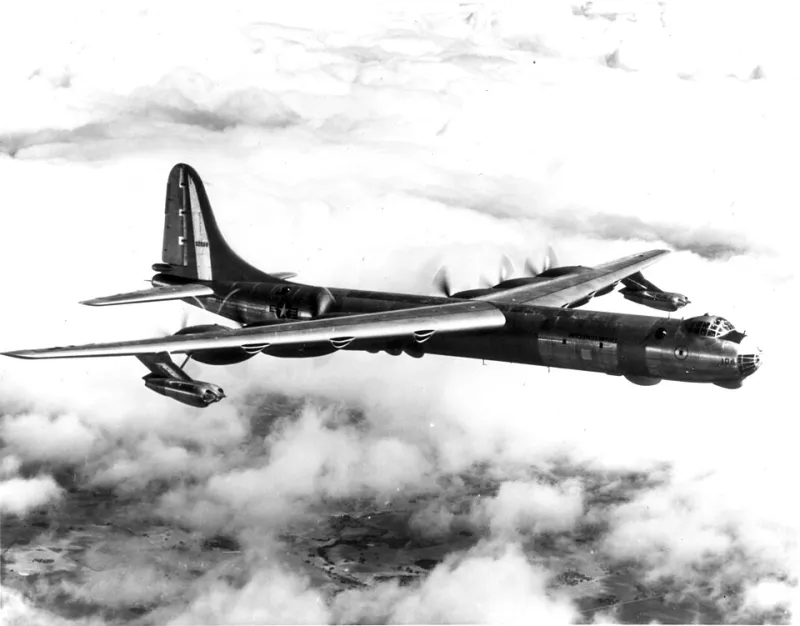
Photo: Unknown, Public domain, via Wikimedia Commons
In the tense years following World War II, the United States found itself in an entirely new kind of conflict — one measured not in battlefield casualties, but in megatons, reach, and resolve. At the center of America's answer to Soviet ambition stood a machine unlike anything the world had seen: the Convair B-36 Peacemaker. With a wingspan stretching 230 feet and the ability to deliver nuclear weapons to targets across the Eurasian continent, the B-36 was not merely an aircraft. It was a statement of national will, rendered in aluminum and aviation fuel.
To understand the B-36's strategic significance, one must first appreciate the doctrinal vacuum that existed in 1945. The United States had atomic weapons, but no reliable means of delivering them deep into Soviet territory from American soil. Conventional bombers of the era lacked the range. The newly independent U.S. Air Force, established in 1947, needed a platform that could credibly threaten Moscow from bases in the continental United States — a capability that would fundamentally alter the calculus of superpower confrontation.
The Doctrine of Massive Retaliation Takes Shape
Declassified Strategic Air Command (SAC) planning documents from the late 1940s and early 1950s reveal a deliberate effort to build a deterrent force anchored around the B-36. Under General Curtis LeMay, SAC transformed from a loosely organized bomber command into a precision instrument of nuclear coercion. The B-36 was central to this transformation.
LeMay's philosophy was brutally straightforward: if the Soviet Union believed that any act of aggression would result in the immediate, overwhelming nuclear destruction of its industrial and military infrastructure, it would not act aggressively. The B-36, capable of flying missions exceeding 10,000 miles without refueling, gave SAC the reach to make that threat credible. Former SAC planners who have spoken with aviation historians over the years have described the aircraft as the "cornerstone" of early deterrence — a weapon whose value was measured precisely by its not being used.
This thinking directly informed the Eisenhower administration's formal policy of "Massive Retaliation," articulated by Secretary of State John Foster Dulles in 1954. Though the B-52 Stratofortress was already entering service by that point, the B-36 had spent nearly a decade laying the strategic groundwork for this posture. It was the aircraft that proved the concept.
Forcing Moscow's Hand
Perhaps the most consequential — and least discussed — aspect of the B-36's legacy is what it compelled the Soviet Union to do. Confronted with a bomber that could penetrate their airspace from intercontinental distances, Soviet military planners were forced into a costly and consuming defensive buildup. Resources that might have been directed toward ground forces or naval expansion were instead channeled into interceptor aircraft programs, radar networks, and surface-to-air missile development.
Declassified CIA assessments from the period note that Soviet air defense spending surged dramatically in the early 1950s, in direct response to the perceived B-36 threat. The MiG-17 and subsequent interceptor programs were accelerated, and an entirely new command structure for Soviet air defense — the PVO Strany — was reorganized and expanded. In a very real sense, the B-36 was shaping the Soviet military from the outside, dictating priorities and draining resources without ever crossing a border.
Retired Air Force officers who flew the B-36 during this period have described a quiet awareness of this dynamic. One former pilot, interviewed by aviation historians at a reunion event, recalled being told during his briefings that the aircraft's existence was itself the mission. "We weren't training to fight a war," he explained. "We were training to prevent one."
The Technological Gamble That Paid Off
The B-36 was not without its critics, and the debates surrounding its development and procurement were fierce. The famous "Revolt of the Admirals" in 1949 saw senior Navy officers publicly challenge the Air Force's reliance on strategic bombing — and the B-36 specifically — as the backbone of American defense policy. Congressional hearings were contentious, and accusations of cost overruns and performance shortcomings were leveled at the program.
Yet the aircraft's defenders proved persuasive. The B-36 could fly at altitudes exceeding 40,000 feet — beyond the reach of most contemporary Soviet interceptors — and its range genuinely was intercontinental. When the "six turning, four burning" configuration of its propeller and jet engines was fully optimized, the aircraft represented a formidable technological achievement. The debates, while politically bruising, ultimately reinforced the Air Force's dominant role in Cold War strategy and cemented the primacy of nuclear deterrence as national policy.
A Legacy Written in Absence
What makes the B-36's historical record so unusual — and so instructive — is the nature of its success. The aircraft flew thousands of training sorties, maintained continuous alert postures, and required enormous investments in crews, infrastructure, and logistics. Yet it never dropped a weapon in combat. By every conventional military metric, the B-36 accomplished nothing. By the metrics that actually mattered during the Cold War, it accomplished everything.
The aircraft's deterrent effect cannot be quantified in the way that tank kills or aerial victories can be tallied. But historians who have examined the declassified record consistently conclude that the B-36's presence in the American arsenal forced a degree of restraint on Soviet foreign policy during a period when the boundaries of the postwar world were still dangerously fluid. The Berlin Blockade, the Korean War, and repeated crises in Europe all unfolded in the shadow of a bomber that the Soviets knew they could not easily stop.
Preserving the Memory of Deterrence
For visitors to the B-36 Peacemaker Museum, encountering one of these surviving aircraft in person is a genuinely arresting experience. The sheer scale of the machine — its massive fuselage, its ten engines, its cathedral-like interior — communicates something that photographs and specifications cannot. This was not a weapon designed for elegance or economy. It was designed to be undeniable.
Understanding the B-36's strategic role transforms that encounter into something more than an appreciation of engineering. It becomes a lesson in how nations manage conflict without combat, how technology shapes diplomacy, and how the most powerful weapons in history can fulfill their purpose by sitting on a runway, fully fueled, waiting for an order that never comes.
The Peacemaker earned its name not on a battlefield, but in the long, uncertain peace it helped to preserve.