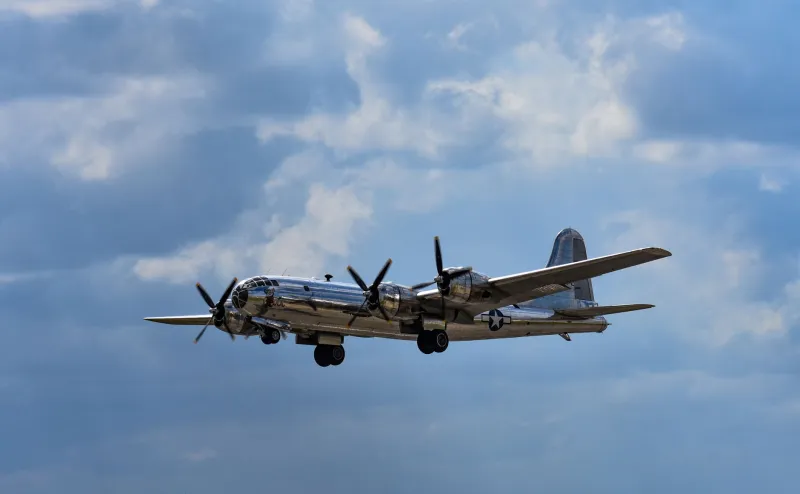
Measured Against the World: How the B-36 Peacemaker Stood Apart From Every Strategic Bomber of Its Era
When the B-36 Peacemaker entered service with Strategic Air Command in 1948, it existed in a class that no other nation's air force could credibly challenge. A systematic comparison with the Soviet, British, and other contemporary strategic bombers of the period reveals not merely a difference in scale, but a fundamental divergence in design philosophy, operational ambition, and technological confidence. The Peacemaker was not simply the largest strategic bomber of its generation — it was, by nearly every meaningful measure, the most ambitious.
The Standard of Comparison
Before examining the Peacemaker's rivals, it is worth establishing what the B-36 actually represented in raw performance terms. The production B-36J, the final and most capable variant, carried a maximum gross takeoff weight of approximately 410,000 pounds. Its combat range without aerial refueling exceeded 3,990 miles with a 10,000-pound bomb load, and the aircraft could operate at altitudes above 45,000 feet — beyond the reach of most interceptor aircraft in service during its operational years. Its bomb bay capacity was without parallel, capable of carrying a nuclear weapon or a conventional bomb load that dwarfed anything a contemporary adversary could field.
Those figures are not merely impressive in isolation. Placed alongside the aircraft that other nations were operating or developing during the same period, they are extraordinary.
The Soviet Challenge: Tupolev Tu-4 and Tu-95
Tupolev Tu-4 (NATO: Bull)
The Soviet Union's most capable strategic bomber at the dawn of the B-36 era was the Tupolev Tu-4, which entered service with the Soviet Air Forces in 1947. The Tu-4's origins are instructive: it was a near-exact reverse-engineered copy of the American Boeing B-29 Superfortress, derived from three B-29s that made emergency landings in Soviet territory during World War II. Stalin ordered the copy to be exact in virtually every detail, and Soviet engineers complied with remarkable fidelity.
The Tu-4 had a maximum range of approximately 3,000 miles — sufficient to reach Western Europe from Soviet bases, but well short of the intercontinental capability that defined the B-36's strategic purpose. Its maximum bomb load was approximately 24,000 pounds, compared to the B-36's 87,200-pound maximum. The Tu-4 operated at a service ceiling of around 36,000 feet, thousands of feet below the B-36's operational altitude.
The comparison is not flattering to the Soviet program. While the Tu-4 represented a significant Soviet achievement in reverse engineering and rapid production, it was fundamentally a World War II-era design operating against a Cold War threat environment. The B-36, by contrast, had been conceived specifically for the intercontinental mission.
Tupolev Tu-95 (NATO: Bear)
The more meaningful Soviet comparison, at least in terms of strategic ambition, is the Tupolev Tu-95, which entered service in 1956 — the same period in which the B-36 was approaching retirement. The Tu-95 was a genuinely impressive aircraft, powered by four massive turboprop engines driving contra-rotating propellers, capable of ranges exceeding 9,400 miles and a service ceiling of approximately 41,000 feet.
In range and endurance, the Tu-95 approached and in some respects matched the B-36. However, the Tu-95 was slower — its maximum speed of approximately 575 miles per hour compared unfavorably with the B-36J's top speed of around 435 miles per hour, though in this case the Soviet aircraft actually held the speed advantage. Where the B-36 retained its edge was in payload capacity and, critically, in the timing of its deployment: the Peacemaker had been providing intercontinental nuclear deterrence for nearly a decade before the Bear achieved operational status.
The Tu-95 remains in Russian Air Force service today, a testament to its fundamental soundness as a design. But it arrived too late to challenge the B-36's dominance during the critical formative years of nuclear deterrence.
The British Contribution: The V-Bombers
Britain's strategic nuclear response to the Cold War took the form of the celebrated "V-bomber" trio: the Vickers Valiant, the Avro Vulcan, and the Handley Page Victor. Each represented a distinct approach to the strategic bombing problem, and collectively they demonstrated the considerable technological sophistication of British aviation in the 1950s.
Vickers Valiant
The Valiant, which entered RAF service in 1955, was conceived as a transitional aircraft — capable enough to provide an interim nuclear deterrent while the more advanced Vulcan and Victor were developed. With a maximum range of approximately 4,500 miles and a service ceiling around 54,000 feet, the Valiant actually exceeded the B-36 in altitude capability. However, its bomb load was considerably lighter, and its range, while respectable, was calibrated for European and Middle Eastern theaters rather than true intercontinental operations.
Avro Vulcan
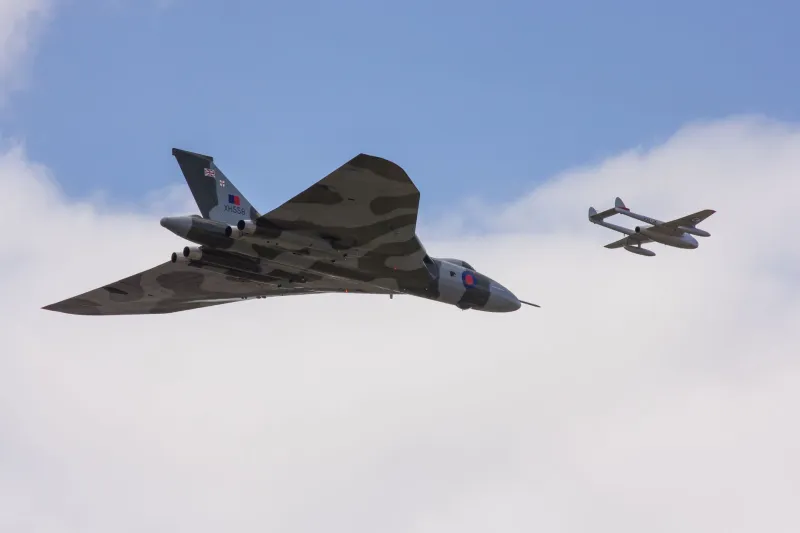
The Vulcan, with its distinctive delta wing and striking silhouette, is arguably the most aesthetically compelling strategic bomber of the Cold War era. Entering service in 1956, it offered a service ceiling above 55,000 feet and a range of approximately 4,600 miles. Its design philosophy — emphasizing altitude and speed over payload — diverged markedly from the American approach embodied in the B-36.
Where the B-36 was conceived as a platform capable of delivering massive bomb loads over intercontinental distances, the Vulcan prioritized high-altitude penetration of Soviet air defenses at ranges relevant to the European strategic context. The two aircraft were solving different versions of the deterrence problem, and that difference in requirement drove a profound difference in design.
Handley Page Victor
The Victor, the most aerodynamically refined of the V-bombers, offered similar performance parameters to the Vulcan with a crescent-wing design that attracted considerable technical admiration. Like its stablemates, it was optimized for the European theater and represented a distinctly British interpretation of strategic air power — elegant, technically sophisticated, but operating at a scale considerably smaller than the American Peacemaker.
Why the American Approach Was Unique
The comparison across these aircraft reveals a fundamental distinction between American and allied or adversary approaches to strategic air power in the early Cold War. The United States, separated from its potential adversaries by two oceans, faced a geographic reality that demanded genuine intercontinental capability. A bomber that could reach Moscow from British bases was useful; a bomber that could reach Moscow from Texas was transformative.
The B-36 was designed to solve that specifically American problem. Its enormous size, its ten-engine configuration, its cavernous bomb bays — all of these characteristics flowed from the requirement to carry nuclear weapons from the continental United States to targets deep within the Soviet Union and return, without depending on overseas basing that might be denied in wartime.
No other nation faced precisely that requirement in the late 1940s. Britain operated from European soil. The Soviet Union was targeting European adversaries from interior positions. The B-36's intercontinental mission was uniquely American, and the aircraft that resulted was correspondingly unique.
The Gold Standard
Soviet military intelligence, according to declassified assessments, regarded the B-36 with a combination of respect and alarm that no other Western aircraft of the period generated. The sheer scale of the Peacemaker's capability — its range, its payload, its operational altitude — forced Soviet planners to invest heavily in interceptor development, radar networks, and surface-to-air missile programs that might not otherwise have been prioritized.
In that sense, the B-36's competitive superiority over its international contemporaries had strategic consequences that extended well beyond the aircraft itself. It shaped Soviet defense investment, influenced NATO planning assumptions, and established the template against which subsequent American strategic bombers would be measured.
For aviation historians and museum visitors examining the surviving B-36 airframes today, the aircraft's place in this international context is essential to a full understanding of its significance. The Peacemaker was not merely larger than its rivals. It was the expression of a distinctly American strategic ambition — and for the critical decade of its service life, that ambition was unmatched anywhere in the world.