Blueprint for the Future: How the B-36 Peacemaker's Legacy Transformed Strategic Bomber Design
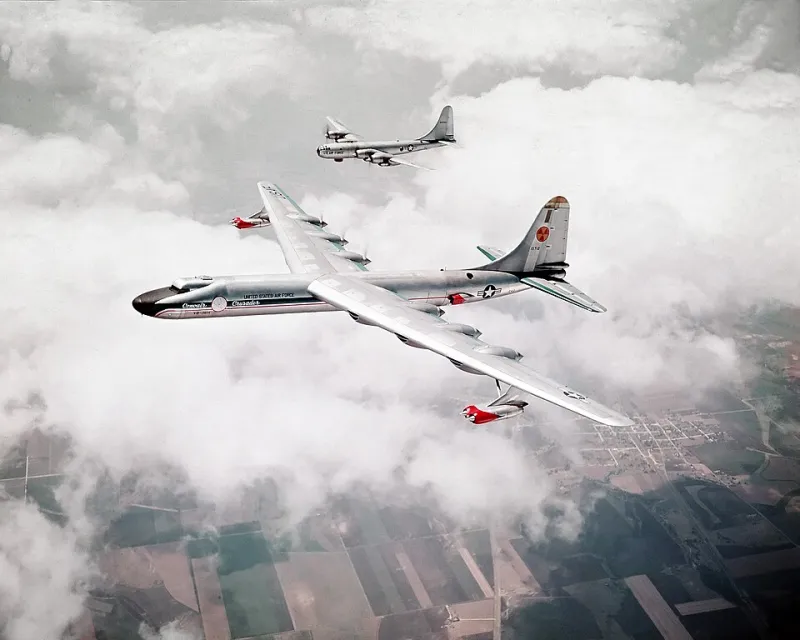
Photo: USAF, Public domain, via Wikimedia Commons
When Convair delivered the first production B-36 to Strategic Air Command in 1948, few observers could have predicted that this lumbering, piston-driven giant would become one of the most instructive aircraft in the history of American military aviation. Not merely because of what it accomplished, but because of what it revealed—about range, altitude, crew endurance, and the profound difficulty of translating strategic ambition into mechanical reality. The lessons embedded in the B-36's design shaped the bombers that succeeded it, and some of those lessons continue to echo in aircraft flying today.
The Ambition That Built a Giant
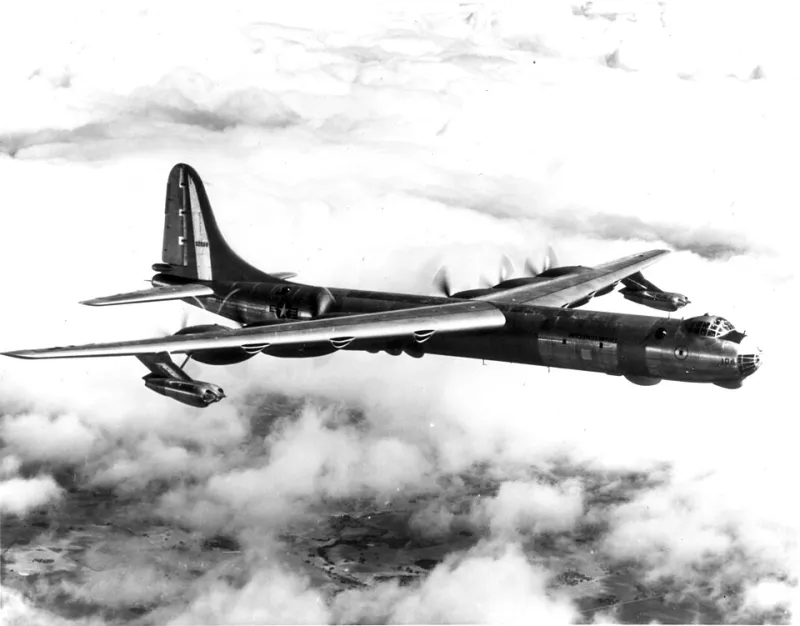
The B-36 was conceived during World War II under a stark strategic premise: the United States might lose its European air bases and still need to strike targets deep inside the Eurasian continent. The solution Convair proposed was audacious—a bomber capable of flying from the continental United States, delivering a payload of conventional or nuclear ordnance, and returning home without refueling. That requirement demanded a wingspan of 230 feet, six radial piston engines, and, eventually, four supplementary jet pods mounted beneath the wings in pairs.
This hybrid propulsion arrangement—the famous "six turning, four burning" configuration—was itself a critical lesson. It demonstrated that no single powerplant technology of the era was sufficient to meet the mission alone. The jets provided the speed and altitude boost necessary for survivability over defended targets; the pistons provided the fuel efficiency required for intercontinental range. The uneasy marriage between these two technologies forced engineers, planners, and pilots alike to confront the trade-offs that define strategic aircraft design to this day.
What the B-47 Learned
Boeing's B-47 Stratojet, which entered service in 1951 and flew alongside the B-36 during the early Cold War, represented a deliberate departure from the Peacemaker's philosophy. Where the B-36 prioritized range above nearly all else, the B-47 embraced jet propulsion entirely, accepting a shorter unrefueled range in exchange for dramatically improved speed and altitude performance. The swept-wing design Boeing employed drew heavily on captured German aeronautical research, but the operational context that made such a design necessary was shaped in no small part by the B-36's demonstrated vulnerability to emerging Soviet jet interceptors.
In essence, the B-36's struggles to achieve adequate cruise speed at high altitude—despite the addition of its jet pods—told Air Force planners that the next generation of bombers could not compromise on propulsion. The B-47's six turbojet engines and swept wing were, in part, a direct answer to the questions the B-36 had raised.
The B-52 and the Enduring Compromise
No aircraft illustrates the B-36's long shadow more clearly than the Boeing B-52 Stratofortress. When the B-52 entered service in 1955, it represented the synthesis of two competing demands that the B-36 had struggled to reconcile: intercontinental range and jet-age performance. Boeing achieved this synthesis through aerial refueling compatibility, a feature that effectively liberated designers from the tyranny of fuel fraction calculations that had driven the B-36 to its enormous proportions.
The B-52 retained the B-36's fundamental strategic logic—a large, high-altitude aircraft capable of delivering nuclear weapons deep into Soviet territory—but shed the piston engines, the extreme wingspan, and the crew of up to fifteen that the Peacemaker required. Where the B-36 needed a relief crew compartment for its long missions, the B-52 relied on aerial refueling to extend its reach without demanding the same physical toll on its airmen.
Yet the B-52 also inherited the B-36's emphasis on internal payload capacity and structural robustness. Both aircraft were designed to carry weapons of extraordinary size and weight, and both were built with sufficient structural margin to absorb decades of modification. The B-52, now over seventy years in service, continues to fly with avionics and weapons systems its original designers could not have imagined—a testament to the same philosophy of structural generosity that characterized the B-36's airframe.
The Obsolescence That Taught
Not every lesson the B-36 offered was a positive one. The aircraft's reliance on defensive gun turrets—eight remotely operated turrets carrying sixteen 20mm cannons—reflected a World War II-era belief that a well-armed bomber could fight its way through enemy defenses. By the mid-1950s, the emergence of Soviet jet interceptors capable of reaching the B-36's cruising altitude had rendered this philosophy dangerously obsolete. The guns added weight and complexity without providing meaningful protection against modern fighters.
This recognition accelerated the shift toward speed and altitude as the primary defensive strategy for subsequent bombers. The B-58 Hustler, which followed the B-52 into service, carried only a single tail gun and relied instead on supersonic speed to evade interception. Later aircraft abandoned defensive armament almost entirely. The B-36's experience with its elaborate gun system helped demonstrate, at considerable expense, that passive defenses could not keep pace with offensive interceptor development.
Crew Systems and Human Factors
Perhaps the most underappreciated influence the B-36 exerted on subsequent design was in the realm of crew systems and human factors. Missions aboard the Peacemaker routinely lasted twenty-four hours or longer, demanding pressurized crew compartments, sleeping accommodations, and meal preparation facilities that no previous bomber had required. The aircraft's designers were compelled to think seriously about crew fatigue, psychological endurance, and the ergonomics of sustained high-altitude flight in ways that directly informed later aircraft.
The B-52's crew compartment design, and later the environmental control systems of the B-1 Lancer and B-2 Spirit, owe a conceptual debt to the hard-won knowledge accumulated during B-36 operations. Strategic bombing, the B-36 demonstrated, was not merely an engineering problem—it was a human endurance problem as well.
A Foundation, Not a Dead End
It would be a mistake to view the B-36 Peacemaker simply as a technological dead end, a transitional aircraft overtaken by the jet age it helped usher in. The aircraft was, rather, a crucible in which the fundamental questions of strategic airpower were tested under operational conditions for the first time. Range versus speed. Piston versus jet. Defensive armament versus aerodynamic performance. Crew comfort versus structural weight. Every compromise the B-36 made, and every limitation it exposed, contributed directly to the design vocabulary of the aircraft that followed.
At the B-36 Peacemaker Museum, we believe that understanding these technological lineages is essential to appreciating both the aircraft itself and the broader history of American airpower. The Peacemaker did not merely deter conflict during its years of service—it educated an entire generation of designers, planners, and airmen whose work continues to shape the strategic bombers flying today.