Contenders for the Crown: The Fierce Design Battle That Determined America's Cold War Bomber
Photo: Unknown authorUnknown author or not provided, Public domain, via Wikimedia Commons
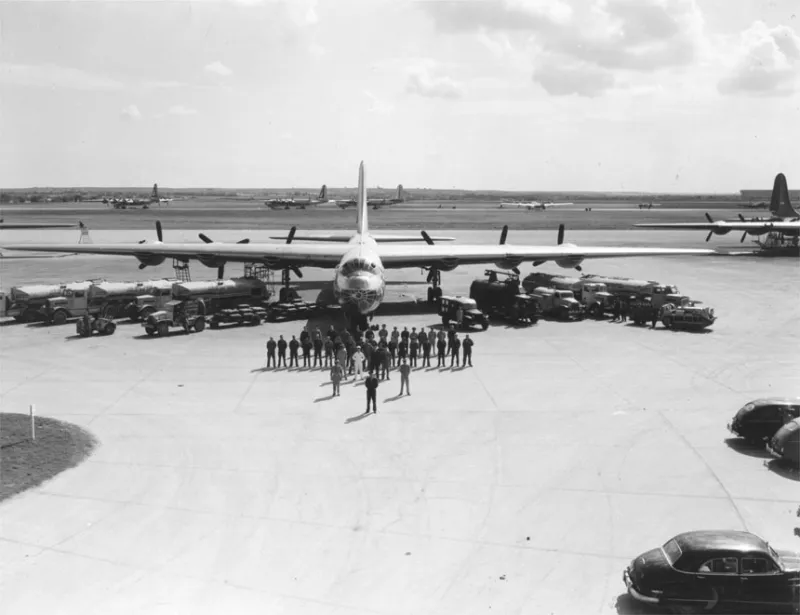
History remembers the B-36 Peacemaker as an icon—an enormous, propeller-driven colossus that stood guard over the free world during the most anxious decades of the twentieth century. Yet the aircraft's dominance was never guaranteed. Behind the familiar silhouette of those six pusher engines and massive 230-foot wingspan lies a story of fierce industrial competition, bureaucratic maneuvering, and engineering decisions that could easily have produced a very different outcome. Understanding that contest illuminates not only why the B-36 succeeded, but also what kind of nation America was becoming as it shouldered the burden of nuclear deterrence.
The Problem That Demanded a Solution
The origins of the competition trace back to the late 1930s and early 1940s, when Army Air Corps planners confronted a sobering strategic reality: if Great Britain fell to Nazi Germany, the United States would need a bomber capable of striking European targets from bases on American soil. That requirement—a combat radius exceeding 5,000 miles while carrying a meaningful bomb load—was so demanding that it effectively disqualified every aircraft then in service or on the drawing board.
In April 1941, the Army issued a formal requirement that called for a maximum range of 10,000 miles, a cruising speed of 240 miles per hour, a service ceiling above 40,000 feet, and the ability to carry 10,000 pounds of ordnance over intercontinental distances. These were not incremental improvements over existing technology. They were specifications that bordered on fantasy, and the manufacturers who answered the call understood that failure could be catastrophic—financially and strategically.
Convair Steps Forward
Consolidated Aircraft Corporation, which would later become Convair, submitted its Model 36 proposal in response to the Army's solicitation. The design was audacious: a high-wing monoplane powered by six Pratt & Whitney R-4360 Wasp Major radial engines mounted in a pusher configuration. The pusher arrangement was unconventional, but it offered aerodynamic advantages by keeping the leading edge of the wing clean and unobstructed.
Convair's proposal was accepted for further development in November 1941, and a contract for two prototypes was signed shortly thereafter. However, the entry of the United States into World War II following Pearl Harbor immediately complicated matters. Wartime production priorities redirected resources toward aircraft already proven in combat, and the B-36 program endured years of delays, funding interruptions, and skeptical scrutiny from officials who questioned whether such an ambitious machine could ever be made to work reliably.
The Boeing Challenge: XB-47 and the Jet Age Argument
Among the most consequential challengers to the B-36's eventual supremacy was Boeing's XB-47 Stratojet, a swept-wing jet bomber that represented an entirely different philosophy of strategic aviation. Where the B-36 was massive, deliberate, and endurance-focused, the XB-47 was sleek, fast, and technologically dazzling. Its six turbojet engines, clustered in underwing pods, gave it a top speed that the propeller-driven B-36 could not hope to match.
Boeing's engineers and advocates argued forcefully that speed was the ultimate defensive asset. A bomber that could outrun enemy interceptors, they contended, needed less armor, fewer defensive guns, and could penetrate Soviet airspace before radar networks could mount an effective response. The XB-47's performance figures were genuinely impressive, and it attracted serious attention from Air Force officers who were increasingly captivated by the promise of jet propulsion.
The debate between the B-36 and jet-powered alternatives was not merely technical—it was philosophical. It asked whether America's strategic deterrent should prioritize range and payload or speed and modernity. The Air Force ultimately concluded, at least for the near term, that neither platform could replace the other. The B-36 entered service first and carried the nuclear mission during the critical years when jet technology had not yet matured sufficiently for intercontinental operations. The XB-47, for all its brilliance, lacked the unrefueled range to strike Soviet targets from American bases.
Northrop's Flying Wing: The Road Not Taken
Perhaps no competing design captured the imagination quite like Jack Northrop's series of flying wing aircraft, culminating in the YB-49. Northrop had long championed the tailless, all-wing configuration as the aerodynamic ideal—a form that minimized drag by eliminating the fuselage and tail assembly entirely. On paper, the advantages were compelling: reduced weight, lower drag, and potentially greater efficiency over long distances.
The YB-49 flew, and it flew impressively in certain respects. But it also exposed the fundamental challenges of flying wing stability and control that would not be solved until the advent of fly-by-wire computer systems decades later. Pilots found the aircraft demanding and unpredictable, particularly during bombing runs that required steady, level flight. The loss of a YB-49 prototype in a 1948 crash, killing the crew, further damaged the program's prospects.
There were also allegations—debated by historians to this day—that political considerations and industrial rivalries influenced the Air Force's decision to cancel the Northrop contract. Jack Northrop himself believed his company had been treated unfairly, and he reportedly made his feelings known to Secretary of the Air Force Stuart Symington in terms that were anything but diplomatic. Whatever the precise mix of technical and political factors, the flying wing's moment would not arrive for another four decades, when Northrop's spiritual successor, the B-2 Spirit, finally vindicated the concept.
Why Convair Won
The B-36's ultimate victory rested on several converging factors. First, it was the only aircraft in serious contention that could credibly fulfill the intercontinental mission without aerial refueling. Its range was not merely adequate—it was extraordinary, routinely demonstrated in flights exceeding 35 hours. Second, Convair had invested years in refining the design, working through production challenges and mechanical problems that would have grounded a less mature program. Third, and perhaps most importantly, the B-36 existed in operational form when the Air Force needed it most. The Berlin Blockade of 1948 and the Soviet Union's first nuclear test in 1949 transformed the strategic bomber from a theoretical requirement into an urgent operational necessity.
The competing designs, whatever their individual merits, were either too immature, too limited in range, or too unstable to fill that role in the critical window between 1949 and the mid-1950s, when jet technology finally caught up with the demands of intercontinental nuclear deterrence.
A Competition Worth Remembering
The aircraft that lost the contest for America's strategic bomber contract did not disappear from history. The XB-47 became the direct ancestor of the legendary B-52 Stratofortress, which continues to serve the U.S. Air Force today. Northrop's flying wing philosophy, discredited in the late 1940s, was redeemed spectacularly in the 1980s. Even the engineering lessons learned from the B-36's own troubled development contributed to subsequent generations of American military aviation.
For visitors to the B-36 Peacemaker Museum, understanding this competitive history adds essential depth to the aircraft on display. The Peacemaker did not succeed by default. It earned its place through a combination of technical merit, industrial perseverance, and the hard realities of a world that could not wait for perfection. That story deserves to be told alongside the aircraft itself.