Measuring the Colossus: The Engineering Marvel That Made the B-36 Peacemaker America's Largest Bomber
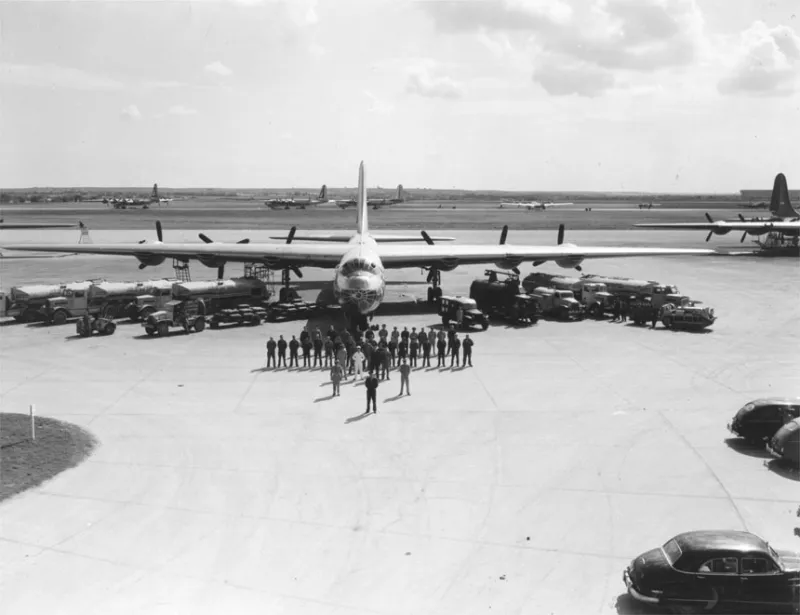
Photo: U.S. Air Force, Public domain, via Wikimedia Commons
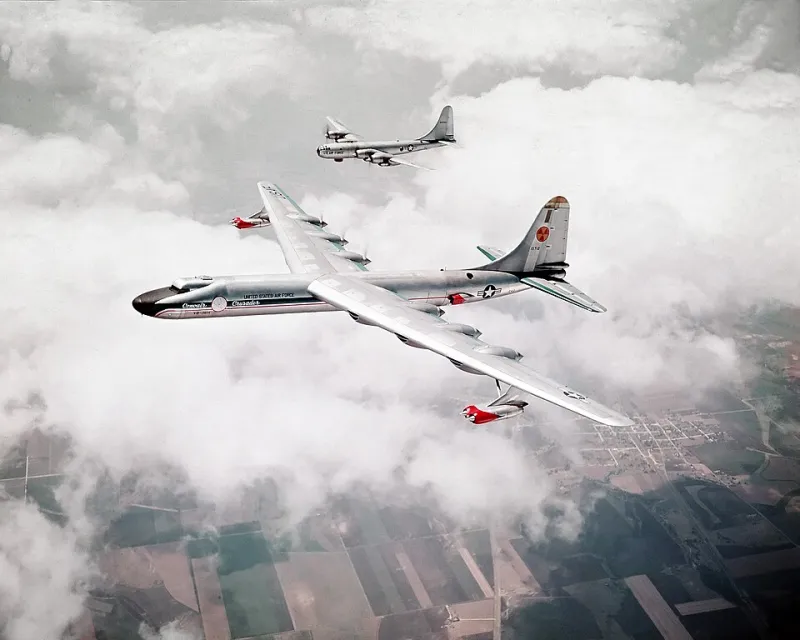
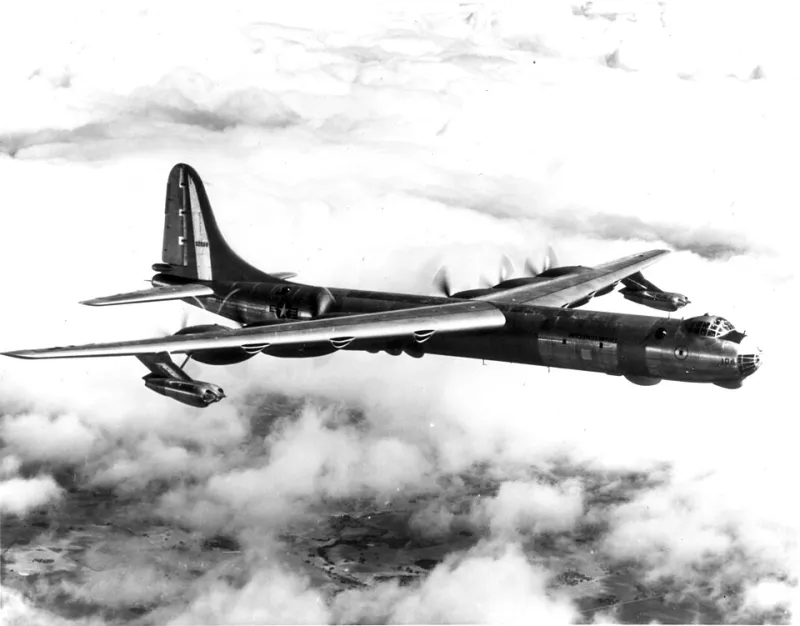
When visitors step into the presence of a preserved B-36 Peacemaker for the first time, the reaction is almost universally the same: a long, wordless pause. Numbers on a specification sheet do not fully prepare the human eye for a wingspan that stretches 230 feet, a fuselage that runs nearly 163 feet in length, or a tail assembly that rises more than 46 feet off the ground. The B-36 was not merely a large aircraft. It was, and remains to this day, the largest bomber ever constructed and operated by the United States military — a distinction that has stood unchallenged for more than six decades.
Understanding why the Peacemaker grew to such extraordinary proportions requires looking back to the strategic circumstances that gave birth to the program in the first place.
A Requirement Born of Necessity
In April 1941, the Army Air Corps issued a formal requirement for a bomber capable of striking targets in Europe from bases located in the continental United States. The premise was sobering: American planners feared that Great Britain might fall to Nazi Germany, eliminating all available forward operating bases across the Atlantic. Any aircraft intended to fulfill this mission would need to carry a meaningful bomb load over a round-trip distance exceeding 10,000 miles — a figure that dwarfed the operational range of every existing bomber design.
Consolidated Aircraft Corporation, which would later become Convair, accepted the challenge. The resulting design demanded a wing of exceptional area to generate sufficient lift for the fuel, crew, and ordnance required by the mission. Engineers settled on a high-aspect-ratio wing with a chord deep enough to allow technicians to service the engines in flight — a remarkable operational feature that underscored just how large the structure truly was.
The final aircraft that emerged from Fort Worth, Texas, beginning in 1947 carried a maximum gross takeoff weight of approximately 410,000 pounds in its later configurations. For context, the legendary B-52 Stratofortress, itself no modest machine, weighs roughly 488,000 pounds at maximum takeoff — but the B-52 achieves that figure through jet propulsion and decades of subsequent design refinement. The B-36 reached its operating weight using a powerplant arrangement unlike anything before or since.
Six Turning, Four Burning
The phrase became a celebrated piece of Air Force vernacular: "six turning, four burning." It described the Peacemaker's hybrid propulsion system — six Pratt & Whitney R-4360 Wasp Major radial piston engines driving pusher propellers, supplemented by four General Electric J47 turbojet engines mounted in underwing pods. Each R-4360 displaced 4,362 cubic inches and produced approximately 3,800 horsepower in its most powerful variants. Combined with the four jets, the aircraft generated a total thrust and horsepower output that was, at the time, without parallel in any operational aircraft anywhere in the world.
That propulsion complexity came at a cost. The R-4360 engines were notoriously maintenance-intensive, and crews frequently contended with in-flight engine failures. The aircraft's sheer size also introduced structural and aerodynamic challenges that Convair engineers spent years resolving through successive model variants, from the initial B-36A through the definitive B-36J.
The bomb bay arrangement reflected the aircraft's scale in equally dramatic fashion. The B-36 featured four separate bomb bays capable of accommodating a total conventional bomb load of up to 86,000 pounds — a figure that exceeds the maximum payload of the B-52 and dwarfs the internal capacity of the B-2 Spirit stealth bomber, which carries approximately 40,000 pounds. Even accounting for the evolution of precision-guided munitions, which allow modern bombers to achieve far greater effect with smaller payloads, the raw volumetric capacity of the Peacemaker's bomb bays remains a testament to the scale of thinking that produced it.
Comparing Giants Across the Decades
Placing the B-36 alongside its successors reveals how dramatically American bomber philosophy shifted in the decades following the Peacemaker's retirement in 1959.
The B-52 Stratofortress, which entered service in 1955 and continues to serve today, has a wingspan of 185 feet — 45 feet shorter than the B-36. The B-1B Lancer, introduced in the 1980s, features a variable-sweep wing that spans between 78 and 137 feet depending on configuration. The B-2 Spirit, the most technologically sophisticated bomber in the current American inventory, has a wingspan of 172 feet. By every dimensional measure, the Peacemaker stands apart.
This divergence was not accidental. The introduction of intercontinental ballistic missiles in the late 1950s fundamentally altered the calculus of nuclear deterrence, reducing the strategic premium placed on very long-range manned bombers. Simultaneously, advances in radar technology and surface-to-air missile systems made large, slow aircraft increasingly vulnerable over defended airspace. The Air Force's response was to pursue speed, stealth, and reduced radar cross-section rather than raw size and payload capacity.
The B-36 belonged to a specific and unrepeatable strategic moment — a window between the end of World War II and the maturation of ballistic missile technology during which the manned, intercontinental bomber was the only credible means of delivering nuclear weapons across global distances.
Why the Record Has Never Been Broken
One question surfaces repeatedly among aviation historians and museum visitors alike: given the technological advances of the intervening decades, why has no American bomber surpassed the B-36 in physical dimensions?
The answer lies in the intersection of mission requirements and available technology. Modern stealth design principles actively discourage large, flat surfaces that would increase radar reflectivity. The B-2's flying-wing configuration achieves an extraordinarily low radar cross-section precisely because its designers minimized protruding structures and surface discontinuities — goals that are fundamentally incompatible with the B-36's massive fuselage and towering tail. Meanwhile, the precision of modern weaponry means that a single aircraft carrying two or four precision-guided munitions can achieve effects that once required dozens of aircraft dropping hundreds of unguided bombs.
In short, the mission has changed. The B-36 was sized for a world in which delivering meaningful destructive force over intercontinental distances required carrying enormous quantities of relatively imprecise ordnance. That world no longer exists.
A Standard That Endures
The B-36 Peacemaker's dimensional supremacy is not merely a historical curiosity. It reflects a period during which American strategic thought, manufacturing capability, and aeronautical engineering converged to produce something genuinely unprecedented. The aircraft's specifications were not the product of excess or miscalculation; they were the precise answer to a specific and urgent strategic problem.
Preserving examples of the B-36 — as institutions like this museum are committed to doing — means preserving physical evidence of that moment. Standing beside one of these aircraft, it remains possible to comprehend, in a visceral and immediate way, the scale of ambition and the depth of engineering skill that defined American airpower at the dawn of the nuclear age. No photograph, no data table, and no written account fully substitutes for that experience.
The Peacemaker was, and remains, a colossus. Its record stands not because subsequent designers lacked the capability to exceed it, but because the strategic world that demanded such a machine passed into history along with the aircraft itself.