Under the Shadow of Giants: How B-36 Peacemaker Bases Transformed the Towns That Served Them

Photo: 1950s American military base town Cold War era community aerial view, via i.pinimg.com
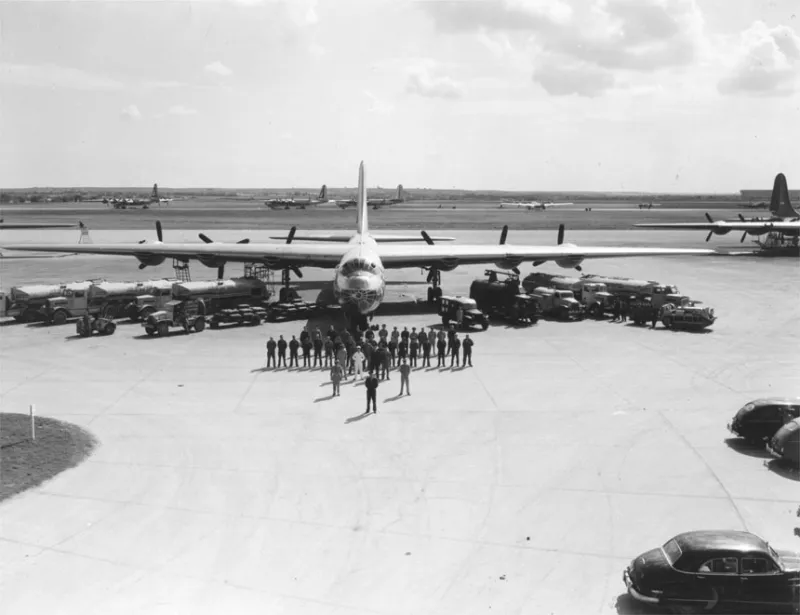
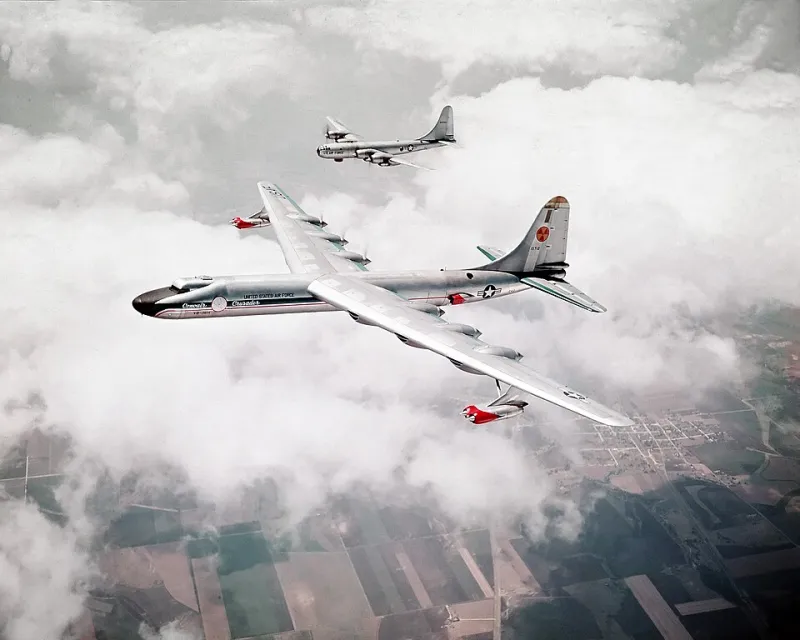
Drive through Carswell, Texas, or Rapid City, South Dakota, or the outskirts of Fairchild Air Force Base near Spokane, Washington, and you will find communities whose physical layouts, economic histories, and collective memories bear the unmistakable imprint of a machine that most of their current residents have never seen. The B-36 Peacemaker — that vast, six-engine colossus that carried America's nuclear deterrent through the most anxious decade of the Cold War — did not confine its influence to the airspace above its targets. It reached down into the towns and neighborhoods surrounding its bases and remade them, quietly and comprehensively, in ways that persisted long after the aircraft itself had been retired.
The Geography of Deterrence
Strategic Air Command's basing philosophy for the B-36 was shaped by operational requirements that had direct consequences for where American communities developed and how they grew. The aircraft's enormous size demanded long, reinforced runways — typically 10,000 feet or more — and substantial ramp space for parking and maintenance. This meant that B-36 bases were, almost without exception, located on flat terrain with generous acreage, often near smaller cities that could provide labor, services, and housing without the congestion that would complicate flight operations.
Carswell Air Force Base, situated on the western edge of Fort Worth, Texas, became one of the most significant B-36 installations in the SAC inventory. Its presence transformed what had been a modest industrial city into a hub of Cold War aerospace activity. The base brought thousands of military personnel and civilian contractors to the region, and the economic ripple effects extended well beyond the base perimeter. Businesses catering to military families — housing developments, retail corridors, schools, and churches — expanded rapidly through the early 1950s, reshaping neighborhoods that had previously been defined by the cattle and oil industries.
The Economy of the Alert Pad
For the towns that bordered B-36 bases, the aircraft represented something more immediate than geopolitical strategy: it represented steady employment and reliable consumer spending. The B-36's maintenance demands were extraordinary. Its eighteen engines — six massive Pratt & Whitney R-4360 Wasp Major radial engines supplemented by four General Electric J47 jet engines — required constant attention from highly trained technicians. Each aircraft carried a crew of up to fifteen men on extended missions, and the administrative, logistical, and support infrastructure required to sustain a wing of B-36s employed thousands of civilians in addition to uniformed personnel.
Local business owners near bases such as Ellsworth Air Force Base outside Rapid City understood this dynamic intimately. "Every payday, the town filled up," recalled one former resident in a memoir archived by a regional historical society. "The airmen had money to spend and not many places to spend it, so the restaurants and the car lots and the furniture stores all did well. When the base was busy, we were busy."
This economic symbiosis created a form of community dependency that carried its own vulnerabilities. When the B-36 was retired and bases transitioned to other aircraft or, in some cases, reduced their operational footprints, the economic disruption in surrounding communities could be severe. The relationship between the bomber and the town was not merely cultural — it was financial, and its unwinding left marks that some communities took decades to recover from.
Family Life in the Nuclear Shadow
For the families of B-36 crewmen, life near a SAC base had a quality unlike that of any other military posting. The B-36's missions were long — some training sorties lasted more than twenty hours — and the operational security requirements that governed SAC meant that spouses and children often knew little about where their husbands and fathers were flying or what they were carrying. This culture of enforced silence shaped family relationships in ways that were simultaneously ordinary and deeply unusual.
Children who grew up near B-36 bases in the early 1950s describe a childhood defined by the constant presence of enormous aircraft overhead and an ambient awareness — never fully articulated, rarely directly discussed — that the machines their fathers maintained were connected to weapons of world-ending power. "We didn't talk about it," one former dependent recalled in a community history project. "But you knew. You'd see the planes taking off at all hours, and you knew what they were for. It was just part of the background of your life."
Civil defense activities reinforced this awareness. Communities near B-36 bases participated in the same duck-and-cover drills and air raid exercises that characterized Cold War America broadly, but with an added layer of immediacy: the bases themselves were understood to be primary Soviet targets. Local newspapers occasionally published civil defense guidance that was remarkable in its candor about the risks facing communities adjacent to strategic air installations.
Infrastructure and Identity
The physical infrastructure developed to support B-36 operations left permanent marks on the communities that hosted these bases. Roads were widened and reinforced to accommodate the movement of oversized equipment. Utility networks were expanded to serve the enormous power demands of base operations. In some cases, entire new neighborhoods were platted and built by the federal government to house military families, creating residential areas whose architectural uniformity and planned layouts distinguished them sharply from the organic development patterns of surrounding civilian communities.
These physical changes were accompanied by subtler shifts in community identity. Towns near major B-36 bases developed a civic pride closely intertwined with their strategic role. Local newspapers covered base milestones — the arrival of a new aircraft model, the achievement of a readiness record, the promotion of a notable officer — with the same attention they devoted to local elections and high school athletics. The base was not merely an employer; it was a source of identity, a point of connection to the larger national narrative of Cold War competition and American strength.
Legacies That Linger
The communities that once lived alongside the B-36 Peacemaker carry its legacy in ways both tangible and intangible. Former base housing developments, now decades removed from their military origins, still stand in neighborhoods across Texas, South Dakota, California, and the Pacific Northwest. Local museums and historical societies in these regions have worked to document the social history of the Cold War base era, recognizing that the stories of the families and business owners who lived in the shadow of the world's largest bomber constitute a significant — and still incompletely understood — chapter in American social history.
At the B-36 Peacemaker Museum, we believe that honoring the aircraft's legacy means honoring the communities it inhabited as much as the machine itself. The Peacemaker did not fly in isolation. It flew from within the fabric of American civic life, and the towns that sustained it deserve to be remembered alongside the aircraft they served.