Unlocking the Vault: Declassified Records Reveal the B-36 Peacemaker's Hidden Role in America's Nuclear Arsenal
Photo: Leonid Faerberg (transport-photo.com), GFDL 1.2, via Wikimedia Commons
The history of the B-36 Peacemaker has always been told in two registers. The first is the public story — the record-breaking range flights, the congressional debates over its cost and viability, the famous "Bomber vs. Carrier" controversy of 1949, and the aircraft's ultimate retirement in 1959. The second register is quieter, more closely held, and only now becoming fully accessible to historians and the public alike through the gradual declassification of Cold War-era military and intelligence documents.
What those documents reveal is both more consequential and more nuanced than the aircraft's public biography has suggested. The B-36 was not simply a large bomber that happened to be capable of carrying nuclear weapons. It was, for a critical period spanning roughly a decade, the primary instrument through which the United States communicated its willingness and capacity to wage atomic warfare — and the platform around which an entire doctrine of strategic deterrence was constructed.
The Architecture of Atomic Deterrence
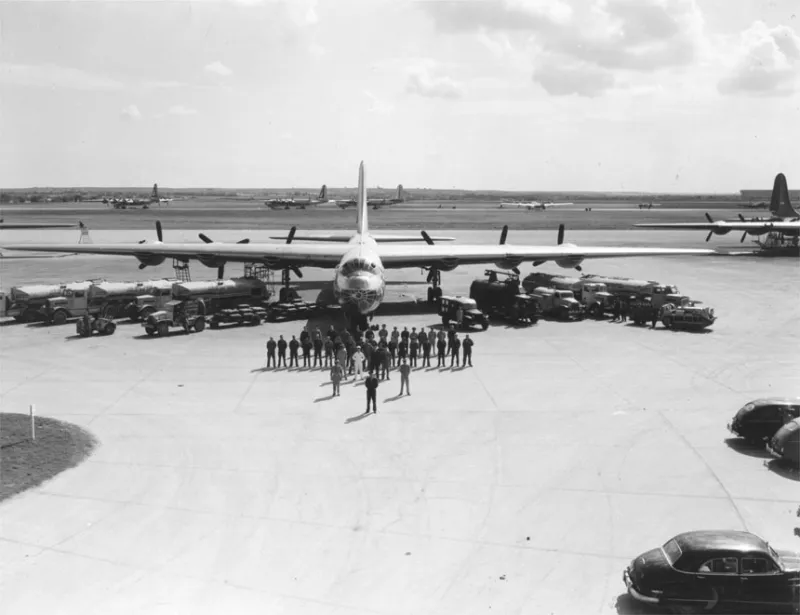
To appreciate the B-36's nuclear significance, it is necessary to understand the strategic environment into which the aircraft was introduced. When the Peacemaker entered operational service with Strategic Air Command in 1948, the United States possessed a nuclear monopoly that was already understood to be temporary. Soviet nuclear ambitions were well known to American intelligence, and the successful Soviet atomic test of August 1949 confirmed that the window of American exclusivity had closed.
In that context, the ability to deliver atomic weapons against Soviet territory from bases in the continental United States was not merely a military capability — it was the foundation of American foreign policy. The B-36, with its intercontinental range and substantial bomb bay, was the only aircraft in the American inventory capable of fulfilling that function without reliance on overseas bases that might be denied, destroyed, or politically unavailable in a crisis.
Declassified Strategic Air Command planning documents, portions of which have been made available through the National Security Archive and through the Air Force Historical Research Agency, describe the B-36 as the "cornerstone" of atomic delivery capability during the late 1940s and early 1950s. These records detail not only the aircraft's technical specifications in the nuclear delivery role but also the command and control procedures, crew training regimens, and alert postures that were developed specifically around the Peacemaker's operational characteristics.
Carrying the Bomb: Technical Realities
The B-36's capacity to carry nuclear weapons evolved considerably across its operational lifespan, and declassified technical records illuminate that evolution in revealing detail.
The earliest atomic weapons in the American arsenal — including the "Fat Man" design used at Nagasaki — were physically enormous, measuring approximately 60 inches in diameter and weighing nearly 10,000 pounds. The B-36's cavernous bomb bays were specifically configured to accommodate weapons of this class, and early operational planning assumed a single-weapon delivery profile on high-priority targets. As American nuclear weapon design matured through the early 1950s and devices became both more powerful and more compact, the B-36's payload flexibility increased substantially.
Declassified weapons loading records and operational test reports describe the aircraft's eventual certification to carry thermonuclear devices of the Mark 17 class — weapons that represented some of the highest-yield warheads ever produced by the United States, with estimated yields in the range of ten to fifteen megatons. The physical dimensions of the Mark 17 required modifications to bomb bay doors and suspension equipment, modifications that are documented in maintenance records now accessible to researchers through archival requests.
These technical details matter not merely as historical curiosities but as evidence of the continuous investment the Air Force made in keeping the B-36 relevant as the nuclear arsenal itself evolved. The aircraft was not a static platform; it was repeatedly modified and recertified to remain at the leading edge of American atomic delivery capability.
Flashpoint Deployments and Crisis Signaling
Perhaps the most historically significant dimension of the newly available documentation concerns the B-36's deployment during specific Cold War crises — instances in which the aircraft's movements were deliberately calibrated to communicate American resolve to Soviet leadership.
During the Korean War, Strategic Air Command conducted a series of B-36 deployments to forward bases in the Pacific theater that, declassified operational orders now confirm, were intended in part as deliberate signals of American nuclear readiness. The movements of specific bomb wings, the positioning of support aircraft, and the public acknowledgment of certain exercises were all elements of a carefully managed signaling strategy. The B-36's intercontinental range meant that even deployments within the continental United States could constitute a meaningful signal — the aircraft did not need to be positioned near Soviet borders to threaten Soviet territory.
Similar dynamics are documented in connection with the 1954 crisis over the Taiwanese Strait and in the broader context of European deterrence throughout the early and middle 1950s. In each case, the documentary record reflects a sophisticated understanding within Strategic Air Command of the B-36 not merely as a weapons delivery platform but as a diplomatic instrument whose visible presence and operational posture carried independent strategic meaning.
General Curtis LeMay, who commanded Strategic Air Command from 1948 to 1957 and who oversaw the B-36's operational deployment throughout most of its service life, understood this dimension of the aircraft's role with particular clarity. His correspondence, portions of which have been declassified through the Library of Congress and the National Archives, reflects a consistent emphasis on the visibility of American nuclear capability as a deterrent force in its own right.
Doctrine Shaped by a Single Platform
The B-36's influence on American military doctrine extended well beyond its own operational service life. The strategic concepts developed around the Peacemaker — assured second-strike capability, visible deterrence, the integration of nuclear weapons into conventional force planning — formed the intellectual foundation upon which subsequent American nuclear strategy was built.
The doctrine of Massive Retaliation, formally articulated by Secretary of State John Foster Dulles in January 1954, drew directly on the operational reality that the B-36 represented. The credibility of that doctrine depended on the existence of a delivery system capable of reaching Soviet targets from American soil under virtually any circumstances. The Peacemaker was that system, and its capabilities defined the boundaries within which strategic doctrine could be responsibly formulated.
When the B-36 was retired and replaced by jet-powered successors including the B-52, the doctrinal framework it had helped establish did not disappear. It evolved, adapted, and ultimately became the bedrock of the nuclear deterrence posture that the United States maintains to the present day.
Preserving the Documentary Record
For institutions dedicated to the preservation of B-36 history, the ongoing declassification of Cold War documents represents both an opportunity and a responsibility. Physical artifacts — airframes, engines, crew equipment — tell one dimension of the Peacemaker's story. The documentary record tells another, and in many respects more consequential, dimension: the story of how this aircraft shaped the decisions and doctrines that defined an era.
The B-36 Peacemaker Museum is committed to incorporating this expanding documentary record into its educational programming and archival holdings. As additional materials become available through declassification processes, the fuller story of the Peacemaker's nuclear role will continue to emerge — enriching our collective understanding of how a single aircraft platform helped to preserve, however precariously, the peace that gave it its name.